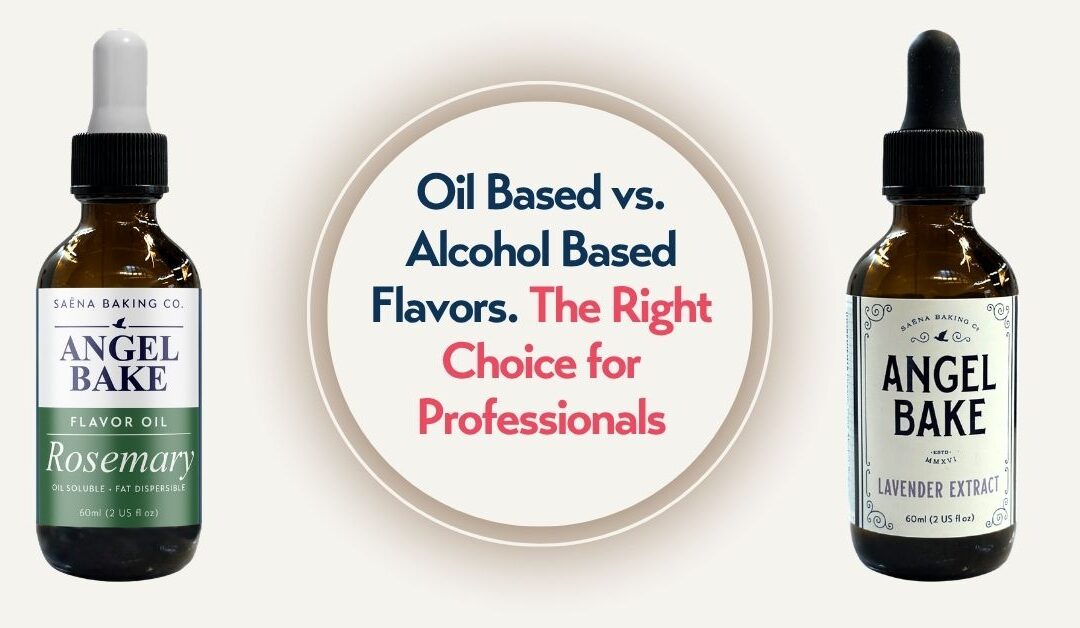
When you are sourcing flavor for a culinary project, the carrier matters as much as the botanical. Oil-based and alcohol-based extracts both deliver extraordinary flavor, but they behave differently in different applications, and choosing the wrong one can affect texture, clarity, and performance in ways you will not discover until the batch is already made.
The fundamental difference
An alcohol-based extract uses food-grade ethanol as its carrier. Alcohol is an excellent solvent. It pulls a wide range of flavor compounds from botanical material efficiently and holds them in stable suspension. The result is a clear or lightly colored liquid that integrates cleanly into most applications.
An oil-based flavor uses a food-grade oil and in the case of Angel Bake Pure Infusions, MCT oil (caprylic/capric triglycerides) derived from coconut as its carrier. Oil captures flavor compounds differently and integrates naturally into fat-based applications without the water-activity concerns that alcohol-based extracts can create in moisture-sensitive work.
Alcohol-based extracts are the workhorses of the culinary world. They belong in baking — cakes, cake filling, cookies, macarons, honey, jams, shortbread, tarts; beverages — lattes, syrups, cocktails, mocktails, cold brew; ice cream and frozen desserts; and sauces and dressings where they disperse evenly through water-based liquids.
Angel Bake Culinary Aromatics extracts are alcohol-based. They are designed for the widest possible range of culinary applications from a lavender latte to a rose macaron, a peppermint bark to a cardamom chai.
When to choose oil-based flavor
Oil-based flavors belong in fat-based applications where water is either absent or a liability. Chocolate is the clearest example — water causes chocolate to seize. Oil-based flavors integrate cleanly without this risk. They are also the right choice for ganache and truffle shells, compound chocolate and coatings, keto fat bombs, and oil-infused preparations like dressings, finishing oils, and infused butters.
Angel Bake Pure Infusions flavor oils use MCT as the carrier chosen specifically because MCT is neutral in flavor, crystal clear, resistant to oxidation, and stable at both room temperature and freezing temperatures. Unlike seed oil carriers, MCT will not go rancid or develop off-notes over time.
The chocolate question
Chocolate is the application where carrier choice matters most. Introduce water into tempered chocolate and it seizes into a grainy, unworkable mass. This is why professional chocolatiers specifically seek oil-soluble flavors for chocolate work. Angel Bake Pure Infusions flavor oils are designed for exactly this application; crystal clear, MCT-based, with no water content.
Can you use them interchangeably?
In most baking and beverage applications, alcohol-based extracts perform beautifully and are the versatile choice. In fat-based, candy, ice cream, and chocolate applications, oil-based flavors are the professional standard. The general rule holds: water-based applications call for alcohol-based extracts, fat-based applications call for oil-based flavors. Our Alcohol based extracts however were originally designed for moisture sensitive applications and as such will introduce insignificant water moisture and have been tested with Chocolate liquor (melted cacao nibs) applications.
Angel Bake: both lines, one standard
Angel Bake offers both product lines to cover every culinary application. The Culinary Aromatics collection covers alcohol-based extracts for baking, beverage, and cocktail applications. The Pure Infusions collection covers MCT-based flavor oils for chocolate, confectionery, and fat-based work. Both lines are Kosher PAREVE certified, NSF GMP-HACCP certified, FEMA GRAS compliant, gluten-free, non-GMO, and vegan.
Explore Culinary Aromatics extracts →
Explore Pure Infusions flavor oils →
An Angel Bake post by Saena Baking Co.
Three letters on a flavor label that most people skip right past — WONF. If you care about what goes into your food, you should know exactly what those three letters mean.
WONF stands for “with other natural flavors”
When a flavor label reads “natural lavender flavor WONF,” it means the product contains lavender flavor — but that lavender flavor has been supplemented with other natural flavoring agents that are not lavender. These additional flavors are used to enhance, round out, or extend the primary flavor while keeping manufacturing costs lower.
The critical word is “other.” A WONF lavender extract is not pure lavender. It is lavender plus something else — and that something else does not have to be disclosed beyond the catch-all term “natural flavors.”
Why manufacturers use WONF
Some botanical extracts are extraordinarily expensive to produce at scale. Pure Bulgarian rose extract, pure saffron, pure vanilla are among the most costly flavor ingredients in the world. WONF formulations allow manufacturers to stretch a small amount of the expensive ingredient with other natural flavors that complement or mimic it, bringing cost down while maintaining a labeling claim that sounds premium.
This is a legal and common practice in flavor manufacturing. It is also a practice that Angel Bake does not use.
What is in the “other natural flavors”?
This is the part that matters most to buyers who read labels carefully. The FDA defines natural flavors broadly: Any flavoring substance derived from plant or animal material through physical, microbiological, or chemical processes. That is a wide net. “Other natural flavors” in a WONF extract could include carrier compounds derived from unrelated plants, flavor modifiers that enhance sweetness, natural flavor chemicals isolated from other botanical sources, or masking agents that suppress off-notes.
None of these need to be named individually. They all travel under the label “natural flavors”, which tells you nothing about their origin, function, or sourcing.
Does WONF mean lower quality?
Not necessarily. WONF formulations can perform well in many applications. But they represent a different product category than a pure extract. If you are buying a lavender extract because you want pure lavender from a specific growing region, with the full terpene profile of the botanical. A WONF product will not deliver that.
Angel Bake and WONF
Every product in the Angel Bake Culinary Aromatics and Pure Infusions collection is WONF-free. Our Bulgarian lavender extract contains Bulgarian lavender. Our Bulgarian Rose extract contains Bulgarian Rose. Our Moroccan orange blossom extract contains Moroccan neroli Bigarade. Our Willamette Valley peppermint extract contains Willamette Valley peppermint.
Explore the Angel Bake Culinary Aromatics collection →
An Angel Bake post by Saena Baking Co.
Something has shifted in how people think about what is in their food. A label that once said “artificially flavored” was unremarkable. Today it is a reason not to buy. Consumer rejection of artificial flavors has accelerated faster than most food manufacturers anticipated — and the trend shows no sign of reversing.
The label-reading revolution
A generation of consumers has grown up reading ingredient labels as a matter of course. What was once the behavior of a niche health-conscious minority is now mainstream. People want to know what is in their food — and when they see “artificial flavor” on a label, the immediate question is: artificial how? Artificial from what? Made to taste like what?
The answer is often complicated. Many artificial flavors are synthesized from petroleum-derived chemicals. Others are produced through chemical modification of natural compounds. The FDA definitions do not make this easy for a consumer to parse — and the opacity is itself the problem.
What consumers are actually asking for
Clean-label research consistently shows that consumers want three things from flavoring: recognizable ingredients they could theoretically source themselves, transparency about origin, and fewer simpler ingredients rather than more complex ones.
This is exactly what a pure botanical extract delivers. “Organic alcohol, water, and steam-distilled Bulgarian lavender” is three ingredients with three clear origins. Every word on that label tells a story someone can understand and verify.
Propylene glycol: the ingredient that accelerated the conversation
One ingredient in particular has driven consumer concern about flavor products in recent years: propylene glycol. A synthetic carrier used in many commercial flavor extracts, propylene glycol is FDA-approved for food use but has faced growing scrutiny as consumers research what is actually in their extracts. When people discover their current brand uses propylene glycol as a carrier, many do not buy it again.
Angel Bake Culinary Aromatics extracts contain no propylene glycol. The carrier is food-grade organic alcohol — a carrier with a history in food as long as food itself.
What “natural flavor” does not tell you
The FDA definition of natural flavor is broad enough to include flavors derived from natural sources through extensive chemical processing — flavors that arrive at a flavor house as raw botanical material and leave as isolated chemical compounds bearing little resemblance to the plant they came from.
This is why the most discerning buyers have moved beyond “natural vs artificial” as the relevant distinction. The better question is: is this a pure extract of a real botanical, or is it a flavoring product assembled from a combination of natural-source compounds? The former is what Angel Bake makes.
A pure botanical extract is the cleanest possible answer to the artificial flavor conversation. There is no synthesis, no chemical modification, no WONF, no propylene glycol, no added sugar. The plant is harvested at peak expression. The flavor compounds are captured through steam distillation or cold extraction. The result is bottled.
What you taste is the botanical — sourced from the place in the world where that botanical grows best. Bulgarian rose from the Rose Valley. Moroccan neroli from the orange blossom groves. Cardamom from high-altitude farms. Peppermint from Oregon’s Willamette Valley.
That is a supply chain decision — one that costs more and demands more rigorous sourcing than assembling a flavor from commodity compounds. It is also exactly what the modern flavor-aware buyer is looking for.
Explore the Angel Bake Culinary Aromatics collection →
An Angel Bake post by Saena Baking Co.
Who Regulates Flavor Products? Understanding the Roles of FDA, TTB, FEMA, and GRAS in the Flavor Industry
The world of flavor manufacturing is governed by several U.S. regulatory bodies and scientific panels that work together to ensure that products—like the pure flavoring extracts made at Saena under the Angel Bake® brand—are safe, transparent, and truthfully represented. Whether you are a chef, food manufacturer, or beverage developer, understanding who does what can help you make more informed decisions when selecting premium flavor ingredients.
Below is a clear breakdown of the major regulators and industry organizations behind flavor safety and compliance in the United States.
FDA — Food & Drug Administration
The U.S. Food & Drug Administration (FDA) oversees the safety of most food ingredients sold in the United States—including natural and artificial flavors.
Under the Federal Food, Drug, and Cosmetic Act, the FDA regulates:
-
Ingredient safety
-
Labeling and claims
-
Good Manufacturing Practices (GMP)
-
Food additives and flavoring substances
-
Adulteration and misbranding protections
For flavor manufacturers like Saena Baking Co., FDA regulations set the framework for:
-
Proper ingredient identity (e.g., “Pure Peppermint Extract”)
-
Safe manufacturing conditions
-
Accurate allergen declarations
-
Clean-label compliance
Learn more:
🔗 FDA on Food Ingredients and Packaging: https://www.fda.gov/food/food-ingredients-packaging
TTB — Alcohol and Tobacco Tax and Trade Bureau
The TTB regulates products that contain alcohol—including many flavor extracts that use alcohol as a solvent.
Extracts such as vanilla, citrus, and botanicals often fall under TTB oversight when they:
TTB’s role includes:
-
Regulating the use and storage of alcohol in manufacturing
-
Approving formulations for alcohol-based extracts
-
Monitoring tax compliance related to alcohol usage
Saena Baking Co. works with TTB-approved formulations to ensure that our alcohol-based extracts meet federal specifications for purity, composition, and manufacturing integrity.
Learn more:
🔗 TTB on Nonbeverage Products and Formulas: https://www.ttb.gov/nonbeverage-products
FEMA — Flavor and Extract Manufacturers Association
The Flavor and Extract Manufacturers Association (FEMA) is not a government agency but a scientific and regulatory industry body.
FEMA is responsible for:
-
Reviewing flavoring substances for safety
-
Publishing expert evaluations
-
Maintaining the FEMA GRAS program (Generally Recognized As Safe)
Many flavoring ingredients used in professional kitchens and food manufacturing facilities—including essential oils—are evaluated through FEMA’s expert panel.
FEMA helps the flavor industry maintain high standards of safety, scientific review, and regulatory alignment with FDA.
Learn more:
🔗 FEMA Official Website: https://www.femaflavor.org/
Understanding GRAS — “Generally Recognized As Safe”
GRAS is a regulatory designation that identifies substances considered safe for use in food under the conditions of intended use.
GRAS determinations can occur in two ways:
-
Through scientific procedures
— Independent experts review available research and determine safety.
-
Through common use in food prior to 1958
— Some ingredients are historically recognized as safe due to long-standing use.
Many natural flavor components—such as citrus oils, peppermint, vanilla, or rose derivatives—are recognized under FEMA GRAS or FDA GRAS criteria.
This provides manufacturers, chefs, and food developers assurance that:
-
The ingredient has undergone scientific review
-
It is accepted for safe use in foods
-
It meets U.S. regulatory expectations
Learn more:
🔗 FDA GRAS Overview: https://www.fda.gov/food/generally-recognized-safe-gras
How These Bodies Work Together
While their responsibilities differ, FDA, TTB, and FEMA collectively create a comprehensive system of oversight:
| Organization |
Role in Flavor Regulation |
| FDA |
Ensures ingredient safety, truthful labeling, GMP, and compliance with food laws |
| TTB |
Regulates alcohol used in extracts, approves formulas, oversees tax compliance |
| FEMA |
Conducts scientific evaluation of flavoring substances; manages FEMA GRAS listings |
| GRAS |
Provides a recognized safety framework for flavor chemicals and natural ingredients |
Angel Bake® extracts are produced within these regulatory frameworks to guarantee safety, purity, and consistency for both professional and home culinary applications.
Why This Matters for Chefs, Bakers, and Food Manufacturers
When you choose a flavoring product—especially for commercial use—you want assurance that:
-
Ingredients are safe and compliant
-
Manufacturing follows strict standards
-
Labels are accurate and transparent