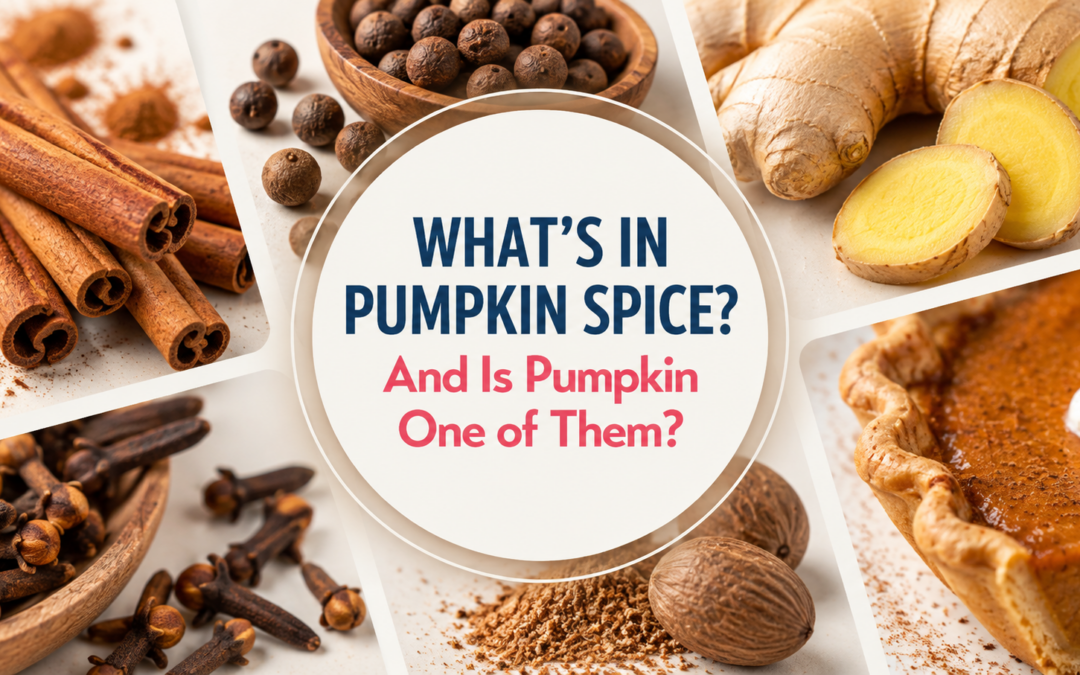
Pumpkin spice does not normally contain pumpkin. It is the family of warm spices traditionally used to season pumpkin pie, and the familiar profile usually begins with cinnamon, ginger, nutmeg, clove, and allspice.
The short answer:
- Pumpkin is not a spice in the blend. The name describes what the blend was made to season.
- Five spices create the familiar profile. Cinnamon leads while ginger, nutmeg, clove, and allspice supply lift and depth.
- Pumpkin still matters in pumpkin foods. Puree contributes color, moisture, body, and a mild squash character.
- The blend can stand on its own. It also works in coffee, cookies, chocolate, and other foods that contain no pumpkin.
The name points to the pie, not the ingredient list
Think of pumpkin spice as a culinary shorthand. Apple pie spice is not made from apples, and poultry seasoning does not contain poultry. In the same way, pumpkin spice is a spice blend associated with pumpkin pie rather than a powdered form of pumpkin.
Recipes vary, but the pattern is remarkably consistent. The University of Maine Cooperative Extension, for example, publishes a simple pumpkin pie spice blend made from cinnamon, ginger, and nutmeg. Many commercial and home blends add clove and allspice.
Pumpkin spice is the seasoning for pumpkin, not pumpkin in spice form.
Five spices create one recognizable autumn profile
| Flavor |
What it contributes |
What happens when it leads |
| Cinnamon |
Sweet warmth and the familiar base |
The blend becomes softer and more bakery focused |
| Ginger |
Peppery brightness and lift |
The finish becomes livelier and less heavy |
| Nutmeg |
Earthy, rounded depth |
The blend reads as fuller and more custard like |
| Clove |
Dark aromatic intensity |
The blend becomes deeper and more assertive |
| Allspice |
A rounded note that connects the other spices |
The blend gains breadth without one spice taking over |
Angel Bake® Pumpkin Spice is a proprietary blend of those five spice notes. The point is not simply to collect five flavors in one bottle. The work is in balancing them so cinnamon remains welcoming, ginger keeps the profile awake, and clove never takes over.
Pumpkin has flavor, but it is not pumpkin spice
Pumpkin does have a mild flavor of its own. Cooked pumpkin can taste gently sweet, earthy, and squash like. In pie, bread, and cheesecake, pumpkin puree also supplies moisture, color, and body. Those qualities are different from the aroma people identify as pumpkin spice.
That distinction explains why a pumpkin spice cookie can taste completely familiar without containing pumpkin, and why plain pumpkin puree can taste surprisingly quiet before spices and sugar are added. One is the produce. The other is the aromatic language built around it.
A useful labeling distinction
Do not promise pumpkin where there is none. A product can honestly be described as pumpkin spice when the flavor is the traditional spice profile. If a formula also contains pumpkin, say so separately.
A prepared blend is convenient, and single spices give you control
For most recipes, a balanced Culinary Aromatics® Pumpkin Spice Extract or Pure Infusions™ Pumpkin Spice Flavor Oil is the simplest starting point. It gives you the full profile without measuring several assertive spices independently.
There are good reasons to customize. A cinnamon forward coffee, a brighter ginger cookie, or a darker clove chocolate should not taste identical. Angel Bake also offers cinnamon, ginger, and clove as individual Culinary Aromatics so you can move the blend in a deliberate direction.
Choose the carrier after you choose the flavor
The same five spice idea is available in two carriers because recipes are not built the same way. Culinary Aromatics use an organic cane sugar ethanol carrier with no added water. Pure Infusions use organic coconut derived MCT and are palm free. Our pumpkin spice extract versus flavor oil guide explains which format belongs in coffee, batter, buttercream, chocolate, and other systems.
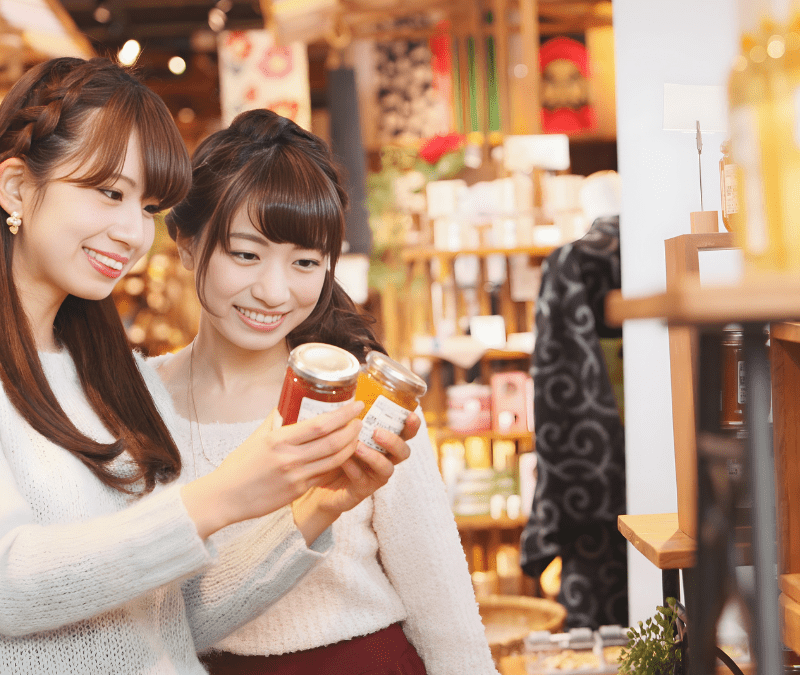
Adding flavor to honey changes what the product is called, what the ingredient statement says, and in some cases what has to appear on the front of the jar. None of it is complicated. It catches producers who have only ever labeled straight honey, and it is far cheaper to know before the artwork goes to print than after.
The short version
- It is no longer just honey. The product name has to describe the characterizing flavor.
- The ingredient statement reads honey, then natural flavor.
- A qualifier may be required on the front panel, at half the height of the flavor name.
- Whether it is required depends entirely on how your flavor supplier built the flavor.
- In a multi flavor pack with shared label copy, one flavor can put that qualifier on all of them.
What this is, and what it is not.
This is a plain summary written from a flavor supplier’s side of the table. It is information about how flavors declare, not legal advice about your package. Your regulatory counsel makes the final call on your label.
Once you add flavor, it is not labeled as honey
FDA has published guidance on the proper labeling of honey and honey products. The relevant point for a flavored product is that when a flavor is added and the labeling represents that flavor, the product name must describe the characterizing flavor. The guidance uses the pattern raspberry flavored honey.
Simply calling the product honey is not correct once flavor is in it.
The varietal trap
A name like lavender honey reads to most shoppers as a varietal claim, meaning honey the bees produced from lavender nectar. That is a different product from honey that has had lavender flavor added to it. If yours is the second thing, the name needs to make that clear.
The ingredient statement
Components are listed by common name in descending order of predominance by weight. For a straightforward flavored honey, that is honey followed by natural flavor.
Two things people ask about. The carrier a flavor is built on is part of the flavor and is generally not called out separately, though a supplier should be able to tell you exactly what is in it and confirm how it declares.
And if you have added anything else, a sweetener, an acid, a preservative, a botanical inclusion, it belongs in the statement too. Adding a second sweetener changes the product name as well.
The qualifier that can land on your front panel
This is the rule that surprises people, and it comes from the flavor labeling regulations rather than the honey guidance. Simplified, there are three cases.
| If the characterizing flavor is |
The label result |
| Derived entirely from the food being named |
The flavor name can stand on its own. No qualifier needed. |
| Derived from the named food, plus other natural flavor that reinforces or rounds it |
The name must be accompanied by with other natural flavors, set at no less than half the height of the characterizing flavor name. |
| Simulated using natural flavor from a different source |
The label must identify the source actually used, or declare the product artificially flavored. |
The qualifier cannot be shrunk into a corner. It sits in your primary display panel, sized against the flavor name.
That half height requirement is what makes this a commercial issue rather than a compliance footnote. The flavor name is generally the largest type on the front of the jar, which sets how much room the qualifier takes with it.
FTNF and WONF, in plain terms
These abbreviations are flavor industry shorthand rather than regulatory terms, but you will hear them from any supplier and they map directly onto the three cases above.
- FTNF, from the named food. Every flavoring component derives from the food being named. An FTNF lavender is built from lavender and nothing else. It does not trigger the qualifier.
- WONF, with other natural flavors. The flavor starts with the named food, then uses natural flavor materials from other sources to build or reinforce the profile. It triggers the qualifier.
A WONF flavor is still entirely natural.
The other natural flavors in the name are exactly that, natural. The qualifier says nothing about synthetic or artificial ingredients. It is a statement about where the flavor came from, not about what kind of flavor it is.
Most commercial botanical flavors are WONF, and that is not a criticism of them. Building a lavender or a chamomile that is stable, consistent, and affordable from that botanical alone is genuinely difficult, and WONF is how most of the industry solves it.
But it is a choice with a labeling consequence, and it is worth knowing what WONF means on a flavor label before the label is designed rather than after.
A worked example: one flavor, a whole line affected
Here is a pattern worth watching for if you produce a multi flavor set or a gift pack.
Imagine a three jar flavored honey set where the packaging carries a single shared piece of label copy across all three products. This is common, because it is cheaper to print and simpler to manage. Two of the flavors come from one supplier and the third from another.
If any one of those flavor systems is a WONF, the qualifier has to appear. And because the copy is shared, it appears across the whole set. The jars whose flavors did not require it carry it anyway.
The practical consequence.
A single supplier choice on one product can determine the front panel of an entire line. If a shorter statement of identity matters to your brand or to your retail customer, audit the composition of every flavor in the set, not only the one you are currently reformulating.
Questions to settle before the artwork goes to print
- Is each flavor FTNF or WONF? Get it in writing, per flavor, not per supplier.
- What is the exact declaration language for each flavor in the ingredient statement?
- Does the product name make clear that the flavor was added rather than derived from the floral source?
- If it is a multi pack with shared copy, has every flavor been checked, not just the new one?
- Does anything else you have added need to appear in the statement, or change the product name?
What this does not cover
This piece is about the flavor related parts of a flavored honey label. It does not address net quantity, nutrition labeling, allergen declarations, country of origin, organic or raw claims, state level requirements, or the other elements a complete label has to satisfy.
It is also not legal advice. Take your draft panel to your regulatory counsel before you print.
For the technical side of choosing a flavor system, see our piece on flavored honey production.
Need the declaration language for a flavor you are considering?
We will send it, along with the specification sheet stating whether the flavor is built from the named food only, and the rest of our documentation. Useful before the artwork goes to print rather than after.
A Buyer’s Guide to Flavor Carrier Selection
When you evaluate a flavor for your product, most of the attention goes to the profile: does the vanilla taste like vanilla, is the lavender true to the botanical, does it hold up in the application. Those questions matter. But there’s another question that experienced formulators learn to ask early, because it determines as much about the finished product as the flavor itself: what carrier is in it?
Every liquid or oil flavor is built on a carrier — the base that delivers the flavor compounds into your product. The carrier is rarely advertised on the front of the bottle, but it travels into everything you make. It affects your label, your allergen statement, your clean-label positioning, and how the flavor behaves on your line. For a home cook, the carrier is a minor detail. For a manufacturer, a beverage developer, or a private-label brand, it’s a sourcing decision with downstream consequences. This guide covers why carrier choice matters and what to evaluate.
Why the carrier matters more than buyers expect
A flavor doesn’t enter your product in isolation — its carrier comes with it. If a flavor is built on a low-quality or questionable base, that base becomes an ingredient in your formulation, with all the labeling and positioning implications that follow.
Three consequences are worth understanding up front.
It shapes your label. The carrier appears, directly or by category, in your ingredient declaration. A clean carrier supports a clean ingredient statement; a carrier full of additives, preservatives, or undisclosed components works against the label you’re trying to build. If you’re developing a clean-label product, the carrier in your flavor either helps you or quietly undermines you.
It affects allergen and dietary claims. The carrier can carry allergen risk, gluten exposure, or ingredients incompatible with non-GMO, organic, or vegan positioning. A carrier sourced from common allergens, or produced in an environment where cross-contact occurs, can compromise claims you depend on — sometimes without your knowledge until a customer or auditor asks.
It influences performance. Carriers behave differently in different systems. Some integrate cleanly into water-based products; others are built for fat-based applications. Some introduce their own character — a base oil with a flavor of its own competes with the profile you actually want. The right carrier disappears into the product and lets the flavor do its job; the wrong one fights you on texture, clarity, or taste.
What to evaluate when you choose a flavor
Treat the carrier as part of your selection criteria, not an afterthought. A few practical questions to put to any flavor supplier:
What is the carrier, specifically? A transparent supplier can tell you the base their flavor is built on and provide documentation to support it. Vague or evasive answers are themselves an answer.
Does the carrier support my clean-label goals? Ask whether the carrier introduces additives, preservatives, or components you’d rather not declare. The fewer questionable elements riding along with the flavor, the cleaner your finished statement.
What are the allergen and dietary implications? Request allergen statements, non-GMO documentation, and — where relevant — organic and kosher documentation. Confirm the carrier is compatible with the claims your product makes.
Where is it produced? The production environment matters as much as the recipe. A flavor can be free of an allergen by formulation and still carry cross-contact risk from the facility it’s made in. Ask about the manufacturing environment, not just the ingredient list.
Is it the right carrier for my application? Match the carrier to your system — water-based or fat-based, high-heat or cold, moisture-sensitive or not. A carrier that performs beautifully in one application can fail in another.
How Saena approaches carrier selection
Saena’s formulation philosophy treats carrier choice as a deliberate quality decision rather than a default. Rather than reaching for the cheapest or most common base, the company selects carriers that support flavor performance, product quality, and our customers’ own clean-label positioning.
In our liquid flavor extracts, that means an organic cane-sugar ethanol carrier rather than conventional corn-derived alcohol. In our food-grade flavor oils, it means an organic coconut-derived MCT oil rather than palm-based oils or commodity seed oils that can introduce their own character into a finished product. These are choices made to support clean-label development, non-GMO positioning, gluten-free compatibility, and organic-focused formulation — so the carrier helps our customers’ claims instead of complicating them.
Production environment is part of the same standard. Our flavors are produced in a dedicated gluten-free, allergen-free facility — meaning major allergens are absent from the production environment, not just from individual recipes. For a buyer building a product around allergen or gluten-free claims, that’s a selection criterion in its own right.
And because manufacturers need more than a finished flavor, we support commercial accounts with the documentation those decisions require: product specifications, certificates of analysis, safety data sheets, allergen statements, non-GMO statements, and kosher documentation where applicable.
The bottom line
The flavor profile is what you taste first, but the carrier is what you live with — on your label, in your allergen statement, and across every batch you produce. Asking “what carrier is in your flavor?” early in the evaluation process protects the claims and the quality you’re building toward. A supplier who can answer it clearly, and back the answer with documentation, is a supplier worth working with.
This post is part of our broader guide to flavor application — how flavor is incorporated, aromatized, finished, and enhanced across food and beverage.
Explore Angel Bake flavor extracts and food-grade flavor oils, review the Angel Bake flavor-format guide, or contact us about documentation, specifications, and made-to-order Culinary Crystals or Encapsulated Essences.
An Angel Bake post by Saena Baking Co.
Three letters on a flavor label that most people skip right past — WONF. If you care about what goes into your food, you should know exactly what those three letters mean.
WONF stands for “with other natural flavors”
When a flavor label reads “natural lavender flavor WONF,” it means the product contains lavender flavor — but that lavender flavor has been supplemented with other natural flavoring agents that are not lavender. These additional flavors are used to enhance, round out, or extend the primary flavor while keeping manufacturing costs lower.
The critical word is “other.” A WONF lavender extract is not pure lavender. It is lavender plus something else — and that something else does not have to be disclosed beyond the catch-all term “natural flavors.”
Why manufacturers use WONF
Some botanical extracts are extraordinarily expensive to produce at scale. Pure Bulgarian rose extract, pure saffron, pure vanilla are among the most costly flavor ingredients in the world. WONF formulations allow manufacturers to stretch a small amount of the expensive ingredient with other natural flavors that complement or mimic it, bringing cost down while maintaining a labeling claim that sounds premium.
This is a legal and common practice in flavor manufacturing. It is also a practice that Angel Bake does not use.
What is in the “other natural flavors”?
This is the part that matters most to buyers who read labels carefully. The FDA defines natural flavors broadly: Any flavoring substance derived from plant or animal material through physical, microbiological, or chemical processes. That is a wide net. “Other natural flavors” in a WONF extract could include carrier compounds derived from unrelated plants, flavor modifiers that enhance sweetness, natural flavor chemicals isolated from other botanical sources, or masking agents that suppress off-notes.
None of these need to be named individually. They all travel under the label “natural flavors”, which tells you nothing about their origin, function, or sourcing.
Does WONF mean lower quality?
Not necessarily. WONF formulations can perform well in many applications. But they represent a different product category than a pure extract. If you are buying a lavender extract because you want pure lavender from a specific growing region, with the full terpene profile of the botanical. A WONF product will not deliver that.
Angel Bake and WONF
Every product in the Angel Bake Culinary Aromatics and Pure Infusions collection is WONF-free. Our Bulgarian lavender extract contains Bulgarian lavender. Our Bulgarian Rose extract contains Bulgarian Rose. Our Moroccan orange blossom extract contains Moroccan neroli Bigarade. Our Willamette Valley peppermint extract contains Willamette Valley peppermint.
Explore the Angel Bake Culinary Aromatics collection →
An Angel Bake post by Saena Baking Co.
Something has shifted in how people think about what is in their food. A label that once said “artificially flavored” was unremarkable. Today it is a reason not to buy. Consumer rejection of artificial flavors has accelerated faster than most food manufacturers anticipated — and the trend shows no sign of reversing.
The label-reading revolution
A generation of consumers has grown up reading ingredient labels as a matter of course. What was once the behavior of a niche health-conscious minority is now mainstream. People want to know what is in their food — and when they see “artificial flavor” on a label, the immediate question is: artificial how? Artificial from what? Made to taste like what?
The answer is often complicated. Many artificial flavors are synthesized from petroleum-derived chemicals. Others are produced through chemical modification of natural compounds. The FDA definitions do not make this easy for a consumer to parse — and the opacity is itself the problem.
What consumers are actually asking for
Clean-label research consistently shows that consumers want three things from flavoring: recognizable ingredients they could theoretically source themselves, transparency about origin, and fewer simpler ingredients rather than more complex ones.
This is exactly what a pure botanical extract delivers. “Organic alcohol, water, and steam-distilled Bulgarian lavender” is three ingredients with three clear origins. Every word on that label tells a story someone can understand and verify.
Propylene glycol: the ingredient that accelerated the conversation
One ingredient in particular has driven consumer concern about flavor products in recent years: propylene glycol. A synthetic carrier used in many commercial flavor extracts, propylene glycol is FDA-approved for food use but has faced growing scrutiny as consumers research what is actually in their extracts. When people discover their current brand uses propylene glycol as a carrier, many do not buy it again.
Angel Bake Culinary Aromatics extracts contain no propylene glycol. The carrier is food-grade organic alcohol — a carrier with a history in food as long as food itself.
What “natural flavor” does not tell you
The FDA definition of natural flavor is broad enough to include flavors derived from natural sources through extensive chemical processing — flavors that arrive at a flavor house as raw botanical material and leave as isolated chemical compounds bearing little resemblance to the plant they came from.
This is why the most discerning buyers have moved beyond “natural vs artificial” as the relevant distinction. The better question is: is this a pure extract of a real botanical, or is it a flavoring product assembled from a combination of natural-source compounds? The former is what Angel Bake makes.
A pure botanical extract is the cleanest possible answer to the artificial flavor conversation. There is no synthesis, no chemical modification, no WONF, no propylene glycol, no added sugar. The plant is harvested at peak expression. The flavor compounds are captured through steam distillation or cold extraction. The result is bottled.
What you taste is the botanical — sourced from the place in the world where that botanical grows best. Bulgarian rose from the Rose Valley. Moroccan neroli from the orange blossom groves. Cardamom from high-altitude farms. Peppermint from Oregon’s Willamette Valley.
That is a supply chain decision — one that costs more and demands more rigorous sourcing than assembling a flavor from commodity compounds. It is also exactly what the modern flavor-aware buyer is looking for.
Explore the Angel Bake Culinary Aromatics collection →
An Angel Bake post by Saena Baking Co.
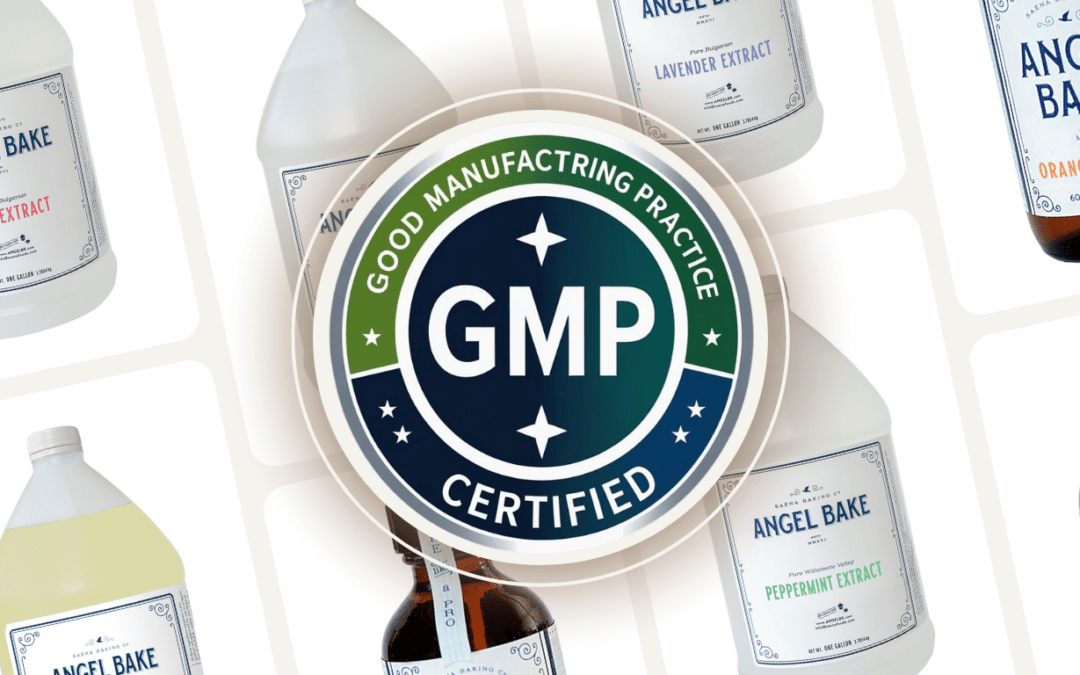
We are proud to announce that Saena has successfully passed NSF Good Manufacturing Practices (GMP) audit with an impressive score of 95.
This independent, third-party audit reviewed every aspect of our production operations. It ensured we meet the highest standards of food safety and quality. The audit evaluated our facility, warehousing and manufacturing processes, employee practices, sanitation protocols, equipment maintenance, pest control, chemical control, packaging and labeling, and more. These are all key components of a robust GMP program.
Achieving this certification is a testament to our unwavering commitment to producing safe, high-quality pure extracts under the Angel Bake™ brand. Our team worked diligently to prepare for this audit documenting all aspects of our operations. They implemented corrective actions where needed and ensured continuous improvement across our operations.
At Saena, we believe food safety is not a one-time accomplishment but a continual journey. That is why, alongside our GMP program, we have developed a full-scale HACCP program. This strengthens our food safety systems further. It ensures that products we produce meets the strictest safety standards while delivering the pure, authentic flavors our customer expect.
We are grateful to our team for their dedication and to our customers for their continued support. We look forward to continuing to provide you with the highest quality extracts, manufactured safely and responsibly at our Portland, Oregon facility.
Key Highlights:
-
NSF GMP audit completed on June 2, 2025 with a score of 95
-
Commitment to continuous improvement and food safety excellence
-
Full HACCP program underway to complement GMP systems
🔗 For more information about our quality standards and products, visit angelbk.com.