Most people think of flavor as a single step: you add something to a recipe, and it tastes like that thing. In practice, flavor is applied to food and drink in several distinct ways, and understanding the differences is the key to getting the result you actually want, whether you’re making a latte at home, developing a dessert menu, or formulating a product at scale.
There are four broad approaches: flavoring, aromatization, finishing, and enhancement. Each one answers a different question. When does the flavor go in? Where does it act, in the food itself, in the air above it, or on the surface? Why are you adding it, to build a profile from scratch or to lift one that’s already there? This guide walks through all four, with examples of when each is the right tool and which kind of flavor is built for the job.
Flavoring
Flavoring is the most familiar approach: direct incorporation into a food or beverage as it’s being made. The flavor becomes part of the formulation itself, distributed through the whole product.
This is what’s happening when you flavor a batch of cookies, stir a botanical profile into a syrup, build a cocktail, or develop a nutritional product. The flavor is in the mix, fully integrated, and every bite or sip carries it. Flavoring is the foundation of most recipes and the starting point for most product development. It’s how you establish the core character of what you’re making.
Common flavoring applications include coffee and tea beverages, baked goods, chocolate and confectionery, sauces and dressings, syrups, ice cream, and nutritional products.
For most flavoring work, Angel Bake’s Culinary Aromatics® liquid extracts are the versatile choice: concentrated, true-to-nature profiles that blend cleanly into beverages, batters, and syrups. For fat-based systems like chocolate, ganache, and compound coatings, our Pure Infusions™ flavor oils are designed to carry flavor where water-based products separate or seize. Choosing between them comes down to your application, and our guide to which flavor format is right for your application walks through it.
Aromatization
Aromatization is about aroma rather than taste. It applies scent to an ingredient, a vessel, or a finished product. Because so much of what we experience as “flavor” is actually smell, aromatization can transform a product’s character without changing its underlying composition.
This is the approach behind aromatizing coffee beans or tea leaves before they’re brewed, scenting a cocktail glass before the drink is poured, or adding an aromatic dimension to a tasting flight or specialty presentation. The aroma does work that taste alone can’t: it sets an expectation, adds complexity, and engages the sense that drives most of flavor perception.
Common aromatization applications include aromatizing coffee beans and roasted coffee, tea leaves and herbal blends, cocktail glassware and beverage vessels, dessert plates, tasting flights, and retail culinary kits.
This is exactly what Angel Bake’s Culinary Aromatics® line is designed to do. It was built with aromatization in mind: it delivers a concentrated, true-to-nature aroma that releases cleanly and lifts immediately, without leaving behind the added moisture that water-based products carry into your ingredient or vessel. That matters most with moisture-sensitive items like coffee beans, tea leaves, and dry blends, where you want the scent and not the dampness. It’s also remarkably good at restoring the bright, fresh top notes that quietly escape coffee, tea, and spices after any length of time in storage, bringing a just-opened liveliness back to ingredients that have gone flat. When aroma is the goal, this is the line to reach for.
Finishing
Finishing is flavor or aroma applied at the very last stage, at the moment a dish or drink is completed or served. Where flavoring builds the profile during production, finishing adds a final, immediate layer of aroma and flavor right before the product reaches the person enjoying it.
A fine-mist application is especially suited to finishing because it lays down flavor precisely and evenly across a surface without adding bulk or moisture. Think of the aromatic lift on top of a latte just before it’s handed across the counter, a mist over a plated dessert as it leaves the kitchen, or a finishing touch on a cocktail at the moment of service. Finishing is where presentation and aroma meet: it’s the first thing the guest notices, and it makes the experience feel fresh and intentional.
Common finishing applications include lattes, cappuccinos, and espresso drinks, cold brew, cocktails and mocktails, ice cream, chocolate, and plated desserts.
Here again, Culinary Aromatics® is in its element. The same clean, moisture-free aroma delivery that makes it ideal for aromatization makes it a natural finishing tool. A light mist sets a fresh aromatic top note on a drink or plate at the moment of service, without diluting or watering down what’s underneath. For service environments and home use alike, it’s a fast, repeatable way to make every cup or plate feel freshly made.
Enhancement
Enhancement uses flavor to support or intensify a profile that’s already present. Rather than introducing a brand-new character, enhancement deepens, rounds out, or reinforces what a product already has, filling in gaps, boosting a note that’s faded, or adding dimension to something that tastes flat.
This is the quiet workhorse of flavor application. It’s what’s happening when a touch of complementary flavor makes a honey taste more like itself, when a beverage concentrate gets a lift before bottling, or when a sauce, dressing, or dairy product gains depth it was missing. Done well, enhancement isn’t noticed as a separate flavor at all. The product simply tastes better, fuller, and more complete.
Common enhancement applications include honey and syrups, beverage concentrates, sauces, dressings, and marinades, dairy products, frozen desserts, chocolate fillings, and specialty culinary products.
Because enhancement is about reinforcing rather than overpowering, it rewards concentrated, true-to-nature flavor used with a light hand, which is the heart of the Angel Bake range. A small amount of Culinary Aromatics® lifts a beverage or syrup, while Pure Infusions™ rounds out chocolate fillings and fat-based sauces. The goal is the same either way: a finished product that tastes more like the best version of itself.
Choosing the right approach
These four approaches aren’t mutually exclusive, and most real-world products use more than one. A signature latte might be flavored with a syrup, finished with an aromatic mist, and served in an aromatized glass. A dessert program might enhance a base recipe and finish each plate at service. The point isn’t to pick a single method but to understand what each one does, so you can combine them deliberately.
Choosing low-calorie syrups over traditional sugary syrups offers a way to reduce calories in your recipes. Low-calorie syrups made with alternative sweeteners are perfect for keto, low-carb, or diabetic-friendly recipes. With the addition of pure extracts, you can create syrups bursting with flavor, making them a healthier and more versatile alternative for beverages, desserts, and more.
Ingredients (Makes approximately 2 cups of syrup)
1 cup water
3/4 cup granulated erythritol (or a mix of erythritol and monk fruit sweetener for a well-rounded sweetness)
1 teaspoon pure extract (e.g., lavender, chocolate, rose, vanilla, etc.)
1/4 teaspoon xanthan gum (optional, for improved consistency and shelf stability)
1/2 teaspoon citric acid (optional, for added shelf life and acidity balance)
1/8 teaspoon potassium sorbate (optional, for preservation and shelf stability)
Instructions
Prepare the Sweetener Base:
In a small saucepan, combine water and granulated erythritol.
Heat over medium heat, stirring frequently, until the sweetener is completely dissolved (do not boil).
Incorporate Additives (Optional):
Slowly sprinkle xanthan gum into the syrup while whisking continuously to prevent clumping. This will slightly thicken the syrup and improve its stability.
Stir in citric acid to enhance flavor, balance acidity, and help preserve the syrup.
Add Flavor:
Remove the saucepan from heat and let the mixture cool to about 120°F (49°C).
Stir in the pure extract of your choice. Start with 1 teaspoon, then adjust to taste. Pure extracts are concentrated, so a little goes a long way.
Preserve and Bottle:
If making the syrup for extended storage, mix in potassium sorbate to act as a preservative.
Pour the syrup into a sterilized glass bottle or jar and seal tightly.
Storage and Shelf-Life Tips
Store the syrup in the refrigerator for up to 2 weeks if no preservatives are added.
With potassium sorbate, the syrup can last up to 3 months when refrigerated.
For longer shelf life (up to 6 months), pasteurize the syrup by heating it to 180°F (82°C) before bottling it in sterilized containers.
Always use clean utensils when handling the syrup to avoid contamination.
Suggested Flavors and Pairings
Lavender Syrup: Adds a calming floral note to iced teas, lattes, lemonades, or cocktails.
Chocolate Syrup: Perfect for mochas, hot cocoa, or drizzling over low-calorie desserts like yogurt or keto pancakes.
Rose Syrup: Elevates rose-flavored sodas, mocktails, lattes, or Middle Eastern-inspired desserts.
Vanilla Syrup: A classic for flavoring coffee, tea, or as a sweetener for smoothies.
Orange Syrup: Brightens cocktails, sparkling water, or even savory marinades for a gourmet twist.
Additional Tips for Versatile Use
While syrups are great for adding sweetness and flavor to drinks and desserts, pure extracts offer an even more flexible solution. In many cases, there’s no need to create a syrup at all. Simply add your preferred low-calorie sweetener (like erythritol or stevia) directly to your recipe and use a few drops of pure extract for flavor. This allows you to adjust sweetness and flavor intensity separately, giving you greater control over your culinary creations.
By combining low-calorie sweeteners with the intense flavors of pure extracts, you can enjoy delicious, health-conscious recipes without added sugar. Whether you choose to create syrups or use extracts directly, your recipes will be packed with vibrant, natural flavors.
Angel Bake™ extracts are measured in drops, not teaspoons. A cup of coffee takes three to five. A cake batter takes a little more. Here is the rate for everything you are likely to make, the drop to teaspoon conversions for when a recipe calls for volume, and the arithmetic behind how far one bottle goes.
The short version
Drinks, ice cream, fillings and frosting: 3 to 5 drops per cup.
Baking, in batter or dough: 5 to 7 drops per cup.
A quarter teaspoon is about 50 drops. A half teaspoon is about 100. There are about 40 drops in a milliliter.
One 2 oz bottle flavors more than 300 cups at the highest rate on this page. Most uses get closer to 500.
Start low, taste, and adjust. Every base is different, and adding is easy.
First, check which kind of bottle you have
The rates on this page are for the Culinary Aromatics® extracts and Pure Infusions™ flavor oils, which are concentrates dosed by the drop. Our vanilla, chocolate and coffee are not concentrates and are dosed completely differently. If that is what you are holding, skip to vanilla, chocolate and coffee.
Start with the rate for what you are making
The rate depends on whether the flavor goes into something you drink, spoon or spread, or something you bake. Everything you do not bake takes 3 to 5 drops per cup of the thing being flavored. Batter and dough take 5 to 7. That is the whole system, and the same rates apply to Culinary Aromatics® extracts and Pure Infusions™ flavor oils.
Rose water or orange blossom water you mix yourself
1/4 teaspoon, about 50 drops
per cup of water
Cake batter, cookie dough, bread dough, muffins
5 to 7 drops
per cup of batter or dough
Measure against the thing you are adding the extract to, not against the finished product. A quart of ice cream base is four cups, so it takes 12 to 20 drops. A single latte is one cup, so it takes 3 to 5.
Baking takes a little more, and cakes usually want it in the filling
Batter and dough are dense. A cup of cake batter carries far more mass than a cup of coffee, and the flavor has to be tasted through flour, fat, eggs and sugar rather than through water. So the same drops read fainter, and the rate goes up to 5 to 7 per cup to compensate.
For layer cakes and macarons there is a better route than flavoring the batter at all. Put the flavor in the buttercream, the filling or the whipped cream at 3 to 5 drops per cup and leave the cake or shell plain. The flavor sits where the tongue meets it first, it is easier to taste and adjust before assembly, and one batch of neutral shells can carry three different fillings.
Which rate for a syrup
A homemade syrup is a concentrate. A cup of it flavors many drinks, so it takes 1/4 teaspoon, about 50 drops, per cup rather than 3 to 5. If you would rather skip the syrup, add the extract straight to the finished drink at 3 to 5 drops per cup and sweeten separately.
Vanilla, chocolate and coffee work differently
Those three are not concentrates. They are made the traditional way, beans steeped in alcohol for months, the same construction as any bottle you would buy elsewhere, and they are dosed the same way everyone else doses them: by what the recipe asks for.
The gap between the two systems is not small. A teaspoon is about 200 drops, so a conventional extract and a concentrate sit roughly forty times apart. Using the drop rates above on a bottle of our vanilla would put almost no vanilla in the bowl.
What you are doing
What to use
Following a recipe
The amount it calls for, one for one. No conversion
Replacing a whole vanilla bean
1 tablespoon
Swapping vanilla paste and vanilla extract
The same measurement, either direction
Working without a recipe
1 to a few teaspoons in a sweet batter or custard, then taste
There is no servings per bottle figure for these. A 2 oz bottle holds about 12 teaspoons, which is a handful of batches rather than hundreds of cups. The more than 300 cups figure further down this page belongs to the concentrates and does not apply here.
The products dosed this way are the Madagascar vanilla extract in both sizes, the Madagascar vanilla paste, the chocolate extract in both sizes and the coffee extract in both sizes. Everything else in the catalog uses the drop rates above.
Treat the rate as a baseline
The rates above are a starting point, not a specification. They are where we would begin, and they are right for most things most of the time. Some recipes will want a little less and some a little more. None of that means the rate is wrong. It means the last adjustment belongs to you and your recipe.
On a first batch it is still sensible to begin at the low end of the range and come up. The baseline is where you are aiming to land, not where you have to start tasting.
Acid changes which notes come forward. Floral and citrus shift the most
Aerated: whipped cream, mousse, meringue
Start at the low end
Air sets aroma free quickly, so it can read strong straight away and settle down
Delicate bases: plain whipped cream, light custard, a subtle crumb
Often a little less
When the flavor is a background note rather than the point, the baseline can be more than you want
Anything served cold or frozen
Judge it cold, never warm
Cold blunts aroma. A base that tastes right warm will taste flat frozen
Why we do not publish a correction factor. We could give you a number to multiply by. It would be made up. The honest version is the table above and your own taste, because the size of the adjustment depends on your recipe, not on our bottle.
Drops to teaspoons, when a recipe wants volume
Our droppers deliver about 40 drops per milliliter. In our own measurements the alcohol based extracts run a little finer than that, around 46 drops per milliliter, and the flavor oils a little heavier, around 39. Using 40 for both keeps the arithmetic simple and, for the extracts, slightly on the safe side. These are the conversions that follow from it.
Volume
Drops, about
Flavors, at 3 to 5 drops per cup
1 milliliter
40
8 to 13 cups
1/4 teaspoon
50
10 to 16 cups
1/2 teaspoon
100
20 to 33 cups
1 teaspoon
200
40 to 66 cups
2 oz bottle (60 ml)
2,400
480 to 800 cups
Two things worth noticing. A quarter teaspoon flavors a whole two layer cake, which is why a recipe written for a supermarket extract at two teaspoons will badly over flavor if you follow it with ours. And there is no need to count 70 drops into a half sheet. Past about 20 drops, switch to the measured dropper or a quarter teaspoon and work in milliliters.
A quarter teaspoon flavors a whole two layer cake.
Batch sizes: how much for a cake, a quart, a batch of buttercream
Batter volumes below are typical rather than exact. If you know your own batter volume, use that instead. Each row gives the drop range and the measured equivalent to start from.
Cakes and batters, at 5 to 7 drops per cup
What you are making
Batter, about
Drops
Start with
12 cupcakes
3 cups
15 to 21
a scant 1/2 ml
9 x 5 loaf
4 cups
20 to 28
1/2 ml
24 cupcakes or an 8 inch two layer cake
6 cups
30 to 42
a scant 1/4 teaspoon
9 inch two layer, 9 x 13 sheet or 10 inch bundt
7 cups
35 to 49
1/4 teaspoon
Half sheet, 13 x 18
14 cups
70 to 98
a scant 1/2 teaspoon
Full sheet, 18 x 26
28 cups
140 to 196
a scant 1 teaspoon
Frosting, fillings and cream, at 3 to 5 drops per cup
What you are making
Volume, about
Drops
Start with
Buttercream for a two layer cake
4 cups
12 to 20
count the drops
Buttercream for a half sheet
8 cups
24 to 40
a generous 1/2 ml
Whipped cream, one batch
2 cups
6 to 10
count the drops
Ganache or macaron filling
2 cups
6 to 10
count the drops
Frozen, drinks and syrup
What you are making
Volume, about
Drops
Start with
Ice cream base, one quart
4 cups
12 to 20
count the drops
Single latte, coffee or tea
1 cup
3 to 5
count the drops
Pitcher of lemonade or iced tea
8 cups
24 to 40
a generous 1/2 ml
Cocktail batch, 20 servings
5 cups
15 to 25
a scant 1/2 ml
Simple syrup, one quart, to be diluted
4 cups
about 200
1 teaspoon
Syrups and floral waters are concentrates, so dose the concentrate
Everything above is measured against the finished thing, a cup of batter, a cup of frosting, a cup of coffee. Syrups and floral waters are different, because nobody eats a cup of syrup. They get diluted again before anyone tastes them, so the rate has to anticipate that dilution or the flavor disappears on the way to the glass.
Both take 1/4 teaspoon, about 50 drops, per cup of the concentrate you are making. That is roughly ten times the rate you would use on a finished drink, and it is correct, because one cup of syrup goes on to flavor somewhere between eight and sixteen drinks.
What you are making
Per cup
Which lands in the glass at
Flavored syrup for coffee, tea or cocktails
1/4 teaspoon, about 50 drops
3 to 5 drops per finished drink
Rose water or orange blossom water
1/4 teaspoon, about 50 drops
used measure for measure in place of the bought bottle
Replacing floral water a recipe already calls for
You do not have to mix a bottle at all. If a recipe asks for rose water or orange blossom water, count one drop of extract for every teaspoon the recipe calls for. A tablespoon of rose water becomes three drops.
Put back the liquid if the recipe needed it. Three drops replace the flavor of a tablespoon, not the tablespoon of liquid, and in a syrup, a custard or a batter that liquid was doing structural work. In a buttercream or a ganache, leaving it out is the point.
Floral waters are the extreme case of the same idea: the extract runs roughly two hundred times the strength of a bought bottle of rose water. Rose extract vs rose water shows that arithmetic in full, including why the substitution charts you will find elsewhere are written for a much weaker product.
Why one bottle goes so far: the servings math
Servings are a calculation, not a marketing number, so here it is in full. A 2 oz bottle is 60 milliliters. At 40 drops per milliliter that is about 2,400 drops. Divide by the drops you use per cup and you have the cups one bottle flavors.
Drops per cup
Typical use
Cups per 2 oz bottle
3
a light hand in drinks or cream
about 800
5
the top of the drinks and frosting range
about 480
7
the top of the baking range
about 340
That is why we say more than 300 cups per bottle. It is true even if everything you make is cake batter at the top of the range. Used mostly in drinks and fillings, the same bottle is closer to 500 cups. A gallon holds 64 of those bottles, so for production planning the same arithmetic scales without changing.
The same rates apply to flavor oils
Pure Infusions™ flavor oils are dosed exactly like the extracts: 3 to 5 drops per cup for anything you do not bake, 5 to 7 in batter or dough, about 40 drops per milliliter. The difference is where each one belongs. The oils are built for fat: chocolate, ganache, buttercream, shortbread, caramels, ice cream bases. They are not for beverages, tea or coffee, where they will not disperse.
The extracts are water soluble and go almost anywhere, including chocolate and candy, because they carry no added water. If you are choosing between the two for a recipe, pick by what you are flavoring, then dose both the same way.
Getting it right: a few habits that help
Start at the low end and taste. Three drops per cup, then add. You can always put more in; you cannot take it out.
Add extract to the liquid or fat first. A few drops in the milk, the cream or the butter distribute evenly. Drops onto a mound of flour do not.
Count drops below 20, measure above. Past 20 drops use the graduated dropper in milliliters, or a measuring spoon: a quarter teaspoon is about 50 drops.
Flavor fillings, not shells. For macarons and layer cakes, put the flavor in the buttercream or filling and keep the shell or sponge plain.
Taste after it cools. Flavor reads differently hot, so judge a baked item or a syrup once it has come to room temperature before adjusting the next batch.
Write down what worked. Once a batter or a drink is where you want it, the drop count is your recipe from then on. It will not change bottle to bottle.
Making something at production scale
These rates are for kitchens, bars and small batch bakers. If you formulate at production volume, the spec sheet for each flavor carries the commercial use levels and the documents your quality team will ask for. Send an inquiry and we will get them to you.
Pick a flavor and start counting drops
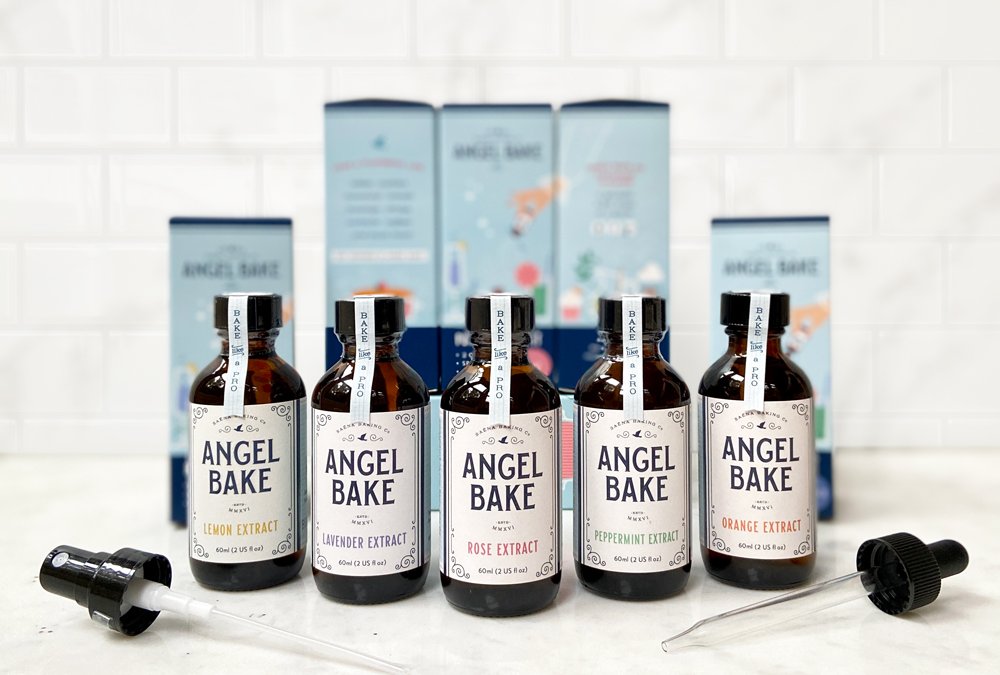
Every 2 oz bottle ships with a dropper. The kit adds a fine mist spritzer for finishing.
At Saena Baking Co., precision matters in both flavor use and ingredient declaration. The following dosage ranges are Angel Bake starting recommendations. Adjust them for the individual flavor, recipe, process, and desired sensory result.
How Much Culinary Aromatics Extract to Use?
Liquids and Recipes Without Baking: Begin with 3 to 5 drops per cup. This range works well for beverages, honey, fillings, syrups, creams, and other applications that are not exposed to baking temperatures.
Baked Goods: Begin with 5 to 6 drops per cup. The additional flavor helps compensate for aroma that may be reduced during baking.
Taste and bench test before scaling. Some flavors may require less. A stronger sensory target or a demanding process may require more.
Choose the Appropriate Format
Culinary Aromatics: Alcohol based, natural, unadulterated FTNF flavors for beverages, syrups, cocktails, finishing, aqueous systems, and compatible culinary applications.
Pure Infusions: MCT based flavor oils that are often the optimal starting point for chocolate, cocoa liquor, ice cream, candy, cake batter, breads, buttercreams, fillings, sauces, dressings, and other oil or fat phase formulations. They also suit many high heat processes.
Culinary Crystals: Made to order dry flavors for dry blending and immediate dispersion.
Encapsulated Essences: Made to order dry flavors for applications that benefit from flavor protection during processing or storage.
Tips for Flavor and Aroma
In syrups, jams, sauces, and creams, later addition can help retain fresh aroma when the process allows it. In other products, earlier addition may be needed for dispersion or processing. Test the flavor in the actual formula and complete production cycle.
Culinary Aromatics can also be applied as a finishing mist. A light spray places concentrated aroma at the surface of a finished food, creating an effect similar to a culinary perfume. Establish the correct dosage and application method before service.
Declaring Flavor Ingredients
Ingredient declaration belongs in the product’s ingredient statement, not the Nutrition Facts panel. Saena provides product specifications to support the customer’s labeling review.
Depending on the product, formulation, jurisdiction, and applicable regulations, the declaration may use a term such as:
Natural flavor or natural flavoring
A named extract, when the specification and applicable standard support that declaration
Do not select a declaration from this article alone. Use the specification for the exact ingredient purchased and confirm the finished label with the responsible regulatory professional. Requirements can change according to product category, market, and jurisdiction.
Quality, Documentation, and Support
Angel Bake Culinary Aromatics are natural, unadulterated FTNF flavors. Saena can provide the appropriate product specification and discuss format selection, recommended use, and application testing without disclosing proprietary formulation details.
Flavored honey is one of the fastest moving parts of the honey category. It is also one of the harder things to get right, because honey is low moisture, high sugar, and sold almost entirely on the idea of purity. Anything you add has to respect all three at once.
What this covers
Four constraints that arrive before flavor performance is even on the table
Three routes manufacturers take today, and the real cost of each
Nine questions worth asking any flavor supplier, including us
What changes on your label the moment flavor goes in
Where Culinary Aromatics fits, including what the carrier does for your hazard analysis
This is written for the people who actually have to make it work, which usually means product development, quality, and whoever ends up owning the label.
Why honey is a difficult matrix to flavor
Most flavor decisions in food manufacturing come down to sensory performance and cost. In honey, four other constraints arrive first.
Moisture is a control point, not a detail
Honey carries moisture in the high teens by percentage, and its low water activity is much of why it stays microbiologically stable at ambient temperature. A flavor system that carries water raises moisture in a product engineered around not having much.
Whether that matters at your inclusion level is worth answering with numbers rather than assumption. It is still the first question to ask.
Crystallization is already a moving target
Crystallization is driven largely by the glucose to fructose ratio of the base honey, which varies by floral source and by season. No flavor supplier can promise your honey will not crystallize.
Be skeptical of anyone who promises otherwise.
The answerable question is whether a flavor system accelerates crystallization, and the only honest way to find out is a shelf study on your base honey rather than a generic one.
The product is sold on being one ingredient
The commercial premise of honey is that it is honey. Every component you add appears on the panel, and in a category where shoppers read panels closely, the length of that statement is part of the product.
That is why the flavor decision is a marketing decision as much as a technical one.
Honey is among the most authenticity tested foods in the world
Packers of any scale run authenticity screening as a matter of routine, including carbon isotope ratio methods for detecting added C4 sugars and multi parameter NMR profiling that evaluates dozens of markers at once.
Any material entering the tank should come from a supplier who can discuss those methods without being surprised by the question.
Very little heat is applied
Most honey packing operations apply minimal heat, so nothing meaningful volatilizes off during processing. What goes in stays in, and flavor systems designed around a bake step or a pasteurization step do not behave the same way here.
In honey, four constraints arrive before flavor performance is even on the table.
The three ways manufacturers flavor honey today
Each is used by real producers, and each carries a real cost.
Botanical infusion
Steeping lavender buds, cinnamon bark, or dried citrus peel directly in the honey. Unbeatable romance, and no flavor supplier on the ingredient statement.
The cost: batch variability from the raw botanical, a filtration step, labor, seasonal supply, and raw plant material entering a product sold on purity.
Natural flavors on a carrier
The standard industry route, from a flavor house on a propylene glycol, ethanol, or water based carrier. Reliable, cost effective at volume, and well documented.
The cost: what the carrier does to a low moisture product, how well it disperses in an aqueous sugar matrix, and whether the flavor is built only from the food being named, which decides what your front panel has to say.
Low moisture extracts
Liquid extracts formulated without added water, typically on an ethanol carrier. They do not fight the moisture constraint and disperse without a premix step in most operations.
The cost: unit price against a commodity flavor, and ethanol carryover into the finished product, which matters if you make an alcohol free claim or hold kosher for Passover or halal certification.
Nine questions worth asking any flavor supplier, including us
These tend to separate suppliers quickly. We would rather you ask them of everyone, us included, than not ask them at all.
What is the carrier, and does it contain added water? Ask for the number, not the adjective. Ask specifically whether it is propylene glycol, the most common carrier in the industry. Note that ethanol at food grade concentrations carries residual water, so no added water and water free are different claims.
Is the flavor built only from the food being named? This is the FTNF and WONF question, and it decides whether your product name has to carry a with other natural flavors qualifier.
Are any of the flavoring components synthetic? Natural flavor is a defined term, and a flavor can meet it while still being built very differently from one supplier to the next. Get the answer in writing rather than inferring it from the declaration.
How does it declare in the ingredient statement? Get the exact declaration language before your artwork goes to print.
What documentation comes with it? Specification, certificate of analysis per lot, allergen statement, safety data sheet, third party food safety certification with the scope page, continuing guarantee letter, and batch traceability.
Have you looked at how it behaves in honey authenticity screening? A supplier who has never considered the question is telling you something.
How should this ingredient sit in our hazard analysis? A supplier who can tell you whether their material supports microbial growth, and back it with the microbiological section of the certificate of analysis, is saving your food safety team work at receiving.
Where in the line does it dose, and does it need a premix? The answer often differs between liquid, creamed, and whipped honey.
What happens when this scales? Lead time, minimum order quantity, monthly capacity per flavor, and the second source position on a single origin botanical.
What changes on your label the moment you add flavor
This surprises people moving into flavored honey for the first time. Under FDA guidance on the proper labeling of honey and honey products, once a flavor is added and the labeling represents that flavor, the product can no longer simply be called honey.
The name has to describe the characterizing flavor, in the form of lavender flavored honey. The ingredient statement then lists components in descending order of predominance by weight, which for most flavored honey means honey followed by natural flavor.
The second rule, which catches more people
It comes from the flavor labeling regulations rather than the honey guidance. If the flavor system draws on natural flavor from outside the food being named, in order to build or reinforce the characterizing note, the product name has to be accompanied by the phrase with other natural flavors.
That phrase has to be set at no less than half the height of the flavor name.
It lands in the middle of your front panel, not quietly on the back. This is why the choice is a brand issue and not a compliance footnote.
In the trade, a flavor built only from the food being named is called FTNF, from the named food. One that reaches outside for support is a WONF, with other natural flavors.
Most commercial botanical flavors are WONF, because building a stable, consistent, affordable lavender from lavender alone is difficult. Which one you buy determines what your printer sets.
We have written a longer piece on this. See our guide to labeling flavored honey for the naming rules, the ingredient statement, and a worked example of how one WONF flavor in a multi flavor set can pull the qualifier onto products that did not need it.
Where Culinary Aromatics fits
Rather than describe it as natural, which is a word without a fixed meaning, here is what is and is not in it.
What is not in it
No synthetic or artificial flavor ingredients. Every flavoring component is natural.
No propylene glycol, the carrier used most widely across the flavor industry.
No added water going into a product where moisture is the constraint.
What is in it
An organic cane sugar ethanol carrier.
Flavor built from the named botanical, so it does not force a with other natural flavors qualifier onto your product name.
A natural flavor declaration. FEMA GRAS compliant.
NSF third party certification for GMP and HACCP, with batch and ingredient traceability and a certificate of analysis on every lot.
Kosher PAREVE through Oregon Kosher, plus Non-GMO, Gluten-Free, and vegan.
Single origin sourcing, including lavender and rose from Bulgaria’s Rose Valley, peppermint from Oregon’s Willamette Valley, orange blossom from Morocco, and cardamom from Central America.
Our lavender is currently in use in a private label flavored honey with national retail distribution.
What the carrier does for your hazard analysis
Ethanol does something in a honey program that has nothing to do with flavor. At the concentration Culinary Aromatics is formulated to, the product does not support microbial growth. The microbiological section of our certificate of analysis reads:
Parameter
Specification
Aerobic plate count
Not applicable
Coliform
Not applicable
E. coli
Not applicable
Yeast and mold
Not applicable
Salmonella and Listeria
Not applicable
Not applicable is not a gap in the paperwork. It is the consequence of a matrix those organisms cannot grow in, and it is why the ingredient does not bring a biological hazard to your receiving step. For a team writing or revising a HACCP plan around a new flavored SKU, that is one fewer preventive control to justify.
What it does not do.
Ethanol at these levels prevents growth. It does not sterilize, and it will not reduce a microbial load already present in your base honey. The benefit is that we are not adding one, not that we are removing one.
Profiles that come up most often in honey
Lavender, Orange Blossom, Orange, Valencia Orange, Lemon, Ginger, Cinnamon, Cardamom, Rose, Chamomile, Rosemary, Peppermint, and Spearmint. We also develop custom profiles for manufacturers whose program needs something we do not already make, at volumes a large flavor house will usually decline.
One note on Orange Blossom.
Orange blossom honey is a varietal with limited and variable supply, which makes it difficult to build a year round program around. The flavor profile does not have that constraint.
A word on claims
You will notice we have not called any of this natural, pure, or clean label. Those words do no work for a reader who has to qualify a supplier.
There is no claim on this page we will not send you the certificate, specification, or statement behind. If you find one, tell us and we will fix it. That is a reasonable standard to hold any supplier to whose material is going into a food sold on purity.
Developing a flavored honey program?
Tell us which profiles are on your roadmap and we will build a bench kit around them, with specifications, the microbiological section of the certificate of analysis, and our full documentation packet. If you would rather talk through volumes and lead times first, that works too.
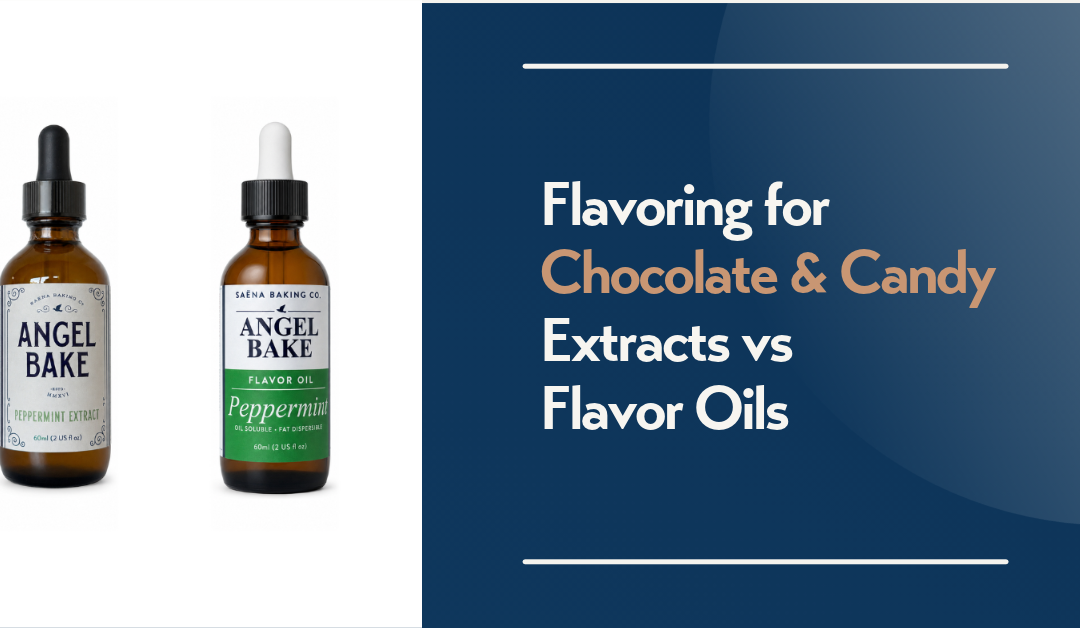
The best flavoring for chocolate and candy depends on what you are making. A bar or a dipped truffle shell wants a flavor oil, because melted chocolate and liquid do not always get along. A ganache, a caramel, or a buttercream center gives you more room, and that is where an extract can shine too.
The short version
Straight into melted chocolate: use a Pure Infusions™ flavor oil.
Ganache, caramel, fudge, and cream centers: either format works; extracts go in with the warm cream.
Vanilla and chocolate extracts: keep them out of melted chocolate. They can make it seize.
Hard candy: add flavor off the heat, after the syrup stops bubbling.
Melted chocolate wants a flavor oil
Chocolate is mostly cocoa butter and fine sugar and cocoa particles. A splash of a water based liquid can make those particles clump into a thick, grainy paste, which chocolatiers call seizing. A flavor oil sidesteps the problem, because it blends straight into the cocoa butter.
Angel Bake Pure Infusions™ flavor oils use an organic coconut derived MCT carrier and are alcohol free. Stir them into tempered or melted chocolate for bars, bark, dipped strawberries, chocolate covered pretzels, coated truffles, and molded bonbon shells. Peppermint bark, orange dark chocolate, and cardamom milk chocolate are three easy places to start.
Vanilla and chocolate extracts are the exception
Our vanilla and chocolate extracts are standard strength extracts, made the traditional way, and they can still seize melted chocolate. Use them in the cream of a ganache, in a caramel, in batter or in frosting. For flavor that goes directly into melted chocolate, choose a flavor oil.
Ganache, truffles, and cream centers give you a choice
A ganache is chocolate and warm cream brought together into a smooth emulsion on purpose, so it handles liquid far better than plain melted chocolate. Add a Culinary Aromatics® extract to the warm cream before you pour it over the chopped chocolate, then stir from the center out. A flavor oil works as well, stirred in once the ganache is smooth.
Rose ganache for macarons, Bulgarian lavender truffles, orange ganache tarts and ginger dark chocolate truffles all start this way. Chocolate extract belongs in the cream too, where it deepens a ganache that will be piped, rolled, or used to fill a cake.
Cooked sugar is very hot, and flavor added at the boil spends its aroma in the steam. Take the pan off the heat first. For caramel and fudge, stir the flavor in just before you pour, when the bubbling has settled. Salted caramel with a little orange, or chocolate fudge with peppermint, are reliable crowd pleasers.
For hard candy and lollipops, use a flavor oil and stir it in quickly once the syrup stops bubbling, then pour. Work carefully, since the syrup is far hotter than boiling water. Cinnamon and peppermint are the classics, and ginger makes a lovely winter drop.
How much to use
Our concentrated extracts and flavor oils go a long way. In chocolate, ganache, fillings, and frosting, start with 3 to 5 drops per cup of the finished mixture. For a pound of melted chocolate, which is roughly a cup and a half, that is about 5 to 8 drops.
Peppermint, clove, and the florals (rose, lavender, orange blossom) are assertive, so start below that range. Vanilla and chocolate extracts are standard strength rather than concentrates, so use the amount your recipe calls for.
The rates above are a starting point. Taste and adjust; every base is different. Our guide to how much extract to use has the full table and conversions.
Valencia orange for the classic chocolate orange in bars and truffles.
Bulgarian rose and raspberry in white or dark chocolate ganache.
Cardamom and ginger for warm, spiced milk chocolate.
Almond and cherry in a cream center or dark chocolate bark.
Finish with aroma
The Culinary Aromatics Kit includes a dropper and a spray nozzle. A light mist over a plated truffle or a slice of chocolate tart, just before serving, puts the aroma in front of the guest before the first bite. Read more about aromatic finishing.
Our Culinary Aromatics extracts and Pure Infusions flavor oils are No Sugar Added, Kosher Pareve, Non-GMO, Gluten-Free and vegan, and a 2 oz bottle of a concentrated flavor covers more than 300 cups.