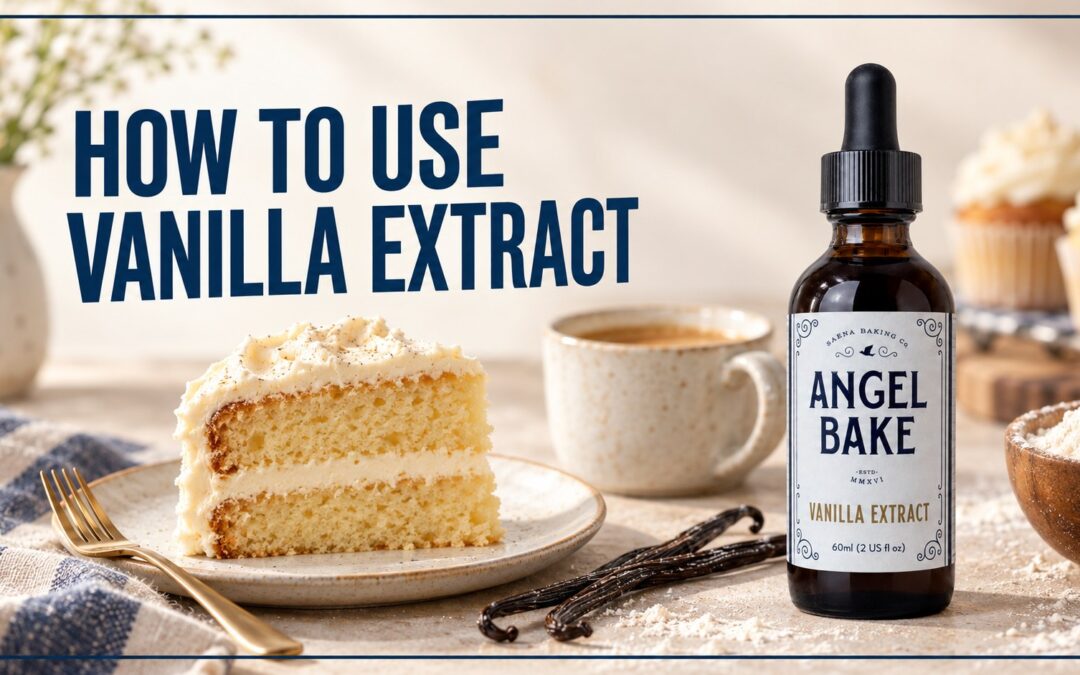
If you are deciding how to use vanilla extract, begin with the role you want it to play. Vanilla can be the flavor everyone notices, or it can sit quietly behind butter, chocolate, coffee, fruit, and warm spices and make the whole recipe feel more complete.
Vanilla works in more than one way
- Let it lead in simple recipes. Shortbread, vanilla cake, custard, whipped cream, and a plain latte give its aroma room to open.
- Use it to connect other flavors. Chocolate, coffee, caramel, nuts, citrus, and spice often taste rounder when vanilla fills the space between them.
- Add it with a compatible liquid. In most batters, drinks, syrups, and frostings, mix the extract into the wet ingredients before the mixture becomes thick.
- Taste the finished application. Cold dairy, hot coffee, baking heat, and strong cocoa can each change how much vanilla you notice.
How to use vanilla extract when vanilla is the main flavor
Vanilla has nowhere to hide in a simple cake, custard, butter cookie, or whipped cream. That is useful. It lets you notice whether the extract reads as warm and woody, soft and floral, or sharp against the other ingredients.
Angel Bake® Pure Madagascar Vanilla Extract combines Planifolia and Tahitian vanilla. Planifolia supplies the familiar deep vanilla body, while Tahitian vanilla contributes a more floral edge. In a simple base, that combination creates dimension without asking sugar to do all the work.
Vanilla extract has a defined identity
The United States standard for vanilla extract specifies vanilla constituents in an alcohol and water solution with at least 35 percent alcohol by volume. You can read the current definition in 21 CFR 169.175. The carrier is part of how vanilla aroma is extracted and delivered, not an accidental ingredient.
Cakes and quick breads want vanilla in the wet phase
For cakes, muffins, loaf cakes, and quick breads, stir the vanilla into the wet ingredients. That may be the eggs, milk, cream, or another liquid component. Early mixing gives the extract a chance to spread before flour thickens the batter.
Vanilla can lead, but it is just as valuable in recipes named for something else. In banana bread it rounds the ripe fruit. In chocolate cake it softens hard edges in the cocoa. In a spice cake it joins cinnamon, ginger, and clove without turning the cake into a vanilla dessert.
Cookies show whether vanilla is a headline or a supporting note
Sugar cookies and shortbread make vanilla easy to recognize. Chocolate chip cookies, molasses cookies, and nut cookies use it differently. There, vanilla sits underneath the obvious flavor and makes the finish feel longer and less abrupt.
Mix the extract with the egg or another wet ingredient before it meets the flour. In a butter rich dough, take a moment to mix thoroughly. A finished cookie should not offer one isolated pocket of aroma and then none in the next bite.
Frosting needs a final taste after the sugar is in
Buttercream can mute vanilla because butter and sugar both absorb attention. Add the extract while the frosting is mixing, then taste only after the texture and sweetness are where you want them. A thin, unfinished frosting will not tell you how the aroma will read on the cake.
Cream cheese frosting brings tang. Chocolate frosting brings bitterness. Meringue buttercream is lighter and less sweet. The same vanilla will seem different in each one, which is why a recipe name is not a substitute for tasting the complete base.
Coffee uses vanilla best when sweetness stays a separate decision
Vanilla and coffee share roasted, warm, and slightly bitter notes, so they meet easily. An unsweetened extract lets you decide how much vanilla the drink needs before deciding how sweet it should be. That is useful in a latte, cold brew, mocha, or a syrup made for several drinks.
In hot coffee, aroma rises quickly. In iced coffee, cold temperature can make it seem quieter. Build the finished drink with milk, ice, and sweetener before making the final judgment.
Custards and cold desserts reveal vanilla after resting
Custard, panna cotta, cheesecake, ice cream, and whipped cream often taste different after chilling. Vanilla that seemed modest while the base was warm may become clearer after the fat has set and the other aromas have settled.
Add the extract at a point where it can disperse evenly, then evaluate the dessert at its serving temperature. That small discipline is more useful than chasing a universal quantity.
| Pair vanilla with |
What vanilla contributes |
Good starting applications |
| Chocolate and cocoa |
Rounds bitterness and extends the finish |
Cake, brownies, frosting, mocha |
| Coffee and caramel |
Connects roasted and cooked sugar notes |
Latte, cold brew, caramel sauce |
| Orange and lemon |
Softens sharp citrus edges |
Cakes, glaze, custard |
| Cinnamon and clove |
Creates a warmer, fuller spice profile |
Cookies, quick breads, holiday drinks |
| Almond and nuts |
Adds softness around toasted notes |
Cookies, pastry cream, frosting |
For the seasonal view, continue to our guide to flavor extracts for holiday baking. Vanilla is the quiet connector in that group, while peppermint, orange, clove, and pumpkin spice provide the more obvious direction.
Short answer: some of it leaves, not all of it, and anyone who tells you it all burns off is repeating something the published data does not support. The better question is why it is in the bottle at all. Alcohol is there because it is the finest carrier of aroma we have, which is the same reason it has been the backbone of perfumery for centuries.
The short version
- Alcohol is the carrier, and that is a design decision. It dissolves aromatic compounds water cannot touch, then releases them cleanly into the air where you can smell them.
- Aroma is most of what you call flavor. A carrier that moves aroma is not packaging. It is the delivery system.
- Some evaporates, some remains. How much depends on method and time, and heat alone does less than people assume.
- Assume none of it leaves and it still barely registers. A teaspoon of vanilla extract holds about as much alcohol as an inch and a half of a light beer, and that teaspoon flavors a whole batch.
- Fat based work is a different problem, and it has its own answer: an oil carrier, built for the job rather than substituted into it.
Alcohol carries aroma better than anything else we could put in the bottle
Open any bottle of perfume and you are holding aromatic compounds dissolved in alcohol. The alcohol is not a diluent and it is not a cost saving. It is volatile, so it lifts off and carries those compounds into the air where your nose can reach them. Take it away and the aroma sits there, sullen and closed. Perfumery settled this question centuries ago and has not revisited it.
Flavor works on the same physics, because most of what you experience as taste is actually smell. Your tongue contributes sweet, salt, sour, bitter and savory. Everything else, the vanilla, the rose, the cardamom, arrives through the back of your nose while you chew. That is why a cake baking fills a house and a photograph of one does nothing.
Food grade alcohol dissolves flavor compounds that water leaves behind, holds them in a stable solution that does not separate or degrade on the shelf, and releases them the moment the extract meets heat, fat or liquid. Nothing else available to a food manufacturer does all three as well.
That is why Culinary Aromatics® are built on an organic cane sugar alcohol carrier with no added water, and it is why the line is named for aroma rather than for taste.
It is also why the range includes a fine mist spritzer. You can aromatize a coffee, a cocktail glass, a plated dessert or a tasting flight at the moment it reaches the guest, putting aroma exactly where it does the most work and adding no moisture at all. We cover that whole approach in flavoring, aromatization, finishing and enhancement, and the carrier question itself in what carrier is in your flavor.
Perfumery settled this centuries ago. Flavor runs on the same physics.
Which is why vanilla extract is legally required to contain it
Under 21 CFR 169.175, the standard of identity for vanilla extract sets the alcohol content at not less than 35 percent by volume. Not as a maximum to be tolerated. As a minimum, below which the product is not vanilla extract.
That standard exists because the people who wrote it understood what makes vanilla extract work. A product below the threshold can be many things, but it cannot carry the name. So when you see a bottle marketed as alcohol free vanilla, read the front panel. It will say flavor, flavoring or essence, and it will be carrying the vanilla in something else.
Some of it leaves during cooking. Not all of it
The United States Department of Agriculture publishes retention factors for alcohol in cooked food, and they are not flattering to the folk wisdom. Heat alone does very little. Stirring an extract into a batter and baking it does not drive the alcohol off the way people picture. Time does more than temperature, and even a long simmer leaves a measurable fraction behind.
So the claim that it all cooks out is not true, and we would rather say so plainly than repeat something comfortable. The useful question is the one nobody asks next: a measurable fraction of what?
What it adds up to, next to a light beer
Take the least favorable assumption available, that not one drop leaves during cooking, and see where it lands.
| |
Alcohol it contains |
| A 12 oz light beer, about 4 percent |
roughly 14 ml |
| A teaspoon of vanilla extract, at the federal minimum of 35 percent |
roughly 1.7 ml |
The whole teaspoon, undiluted and undivided, carries about one eighth of what is in a single light beer. Put another way, it is the alcohol you would get from about an inch and a half of the can.
And nobody drinks the teaspoon. It goes into a batch. If a recipe calls for a teaspoon and the finished batch serves twelve, one serving carries roughly one percent of a light beer. You would need to eat something like a hundred servings, in one sitting, to match one beer. That is before any allowance for the portion that does evaporate, which is real.
Run it on your own recipe
Multiply the volume of extract by its alcohol percentage. That is the alcohol that went in, assuming none leaves. Divide by the number of servings the batch yields.
Compare the result against 14 ml, which is roughly what a light beer holds. We would rather hand you the arithmetic than a reassuring adjective.
What alcohol free actually means on a label
Removing the alcohol does not remove the need for a carrier. Something still has to dissolve the flavor and let it go again. The usual substitutes are propylene glycol, glycerin or water, and each one costs you something.
Propylene glycol is the workhorse of the flavor industry and it appears on your ingredient statement. Glycerin is sweet, which shifts the balance of whatever you add it to. Water based systems need a preservation strategy, because water supports microbial growth that alcohol does not.
Four things we can state about every Culinary Aromatics® extract, each of which sits on a specification sheet rather than in a marketing line:
- No synthetic or artificial flavor ingredients.
- No propylene glycol.
- No added water.
- Built from the named botanical only, which is what keeps a with other natural flavors qualifier off a customer’s front panel.
Where an oil carrier is the better engineering choice
None of this makes alcohol the answer to everything. A carrier has to match the system it is going into, and fat based work is a genuinely different problem.
Our Pure Infusions™ flavor oils carry many of the same botanicals in an organic coconut derived MCT base. They are oil soluble and heat stable, which makes them the right tool for chocolate, ganache, compound coatings, icings, nut butters, dressings and anything else built on fat. That is not a compromise version of an extract. It is a different instrument, and in those applications it is the better one.
The reverse is equally true. An oil will not disperse through a batter, a syrup, a coffee or a cocktail, and an extract will. Choose by the system you are flavoring rather than by which carrier sounds preferable in the abstract. We put the two side by side in oil based versus alcohol based flavor.
There are also reasons to keep alcohol out that have nothing to do with performance. Some are religious, some are personal. For those, an oil based flavoring is the honest alternative, rather than an extract relabelled to sound like one.
Which format fits what you are making
Culinary Aromatics® extracts
Alcohol carrier, no added water. Disperses through batters, doughs, syrups, coffee, tea and cocktails, and sprays as a fine mist for finishing and aromatization.
Water based systems
Pure Infusions™ flavor oils
MCT carrier from organic coconut. Oil soluble and heat stable, built for chocolate, confectionery, icings, nut butters and dressings.
Fat based systems
Both are Kosher PAREVE through Oregon Kosher, Non-GMO, Gluten-Free, and vegan, and both are produced in an NSF third party certified GMP and HACCP facility.
Buying in volume
Bakeries, roasteries, and beverage producers can order the same extracts in 1 gallon and larger sizes, with a certificate of analysis on every lot. Specification sheets are available on request through saenafoods.com.
Alcohol retention behaviour is described by the United States Department of Agriculture nutrient retention factors. The vanilla extract standard of identity is 21 CFR 169.175. Comparison figures use a 12 fl oz light beer at 4 percent alcohol by volume and a US teaspoon of extract at 35 percent.
Most people think of flavor as a single step: you add something to a recipe, and it tastes like that thing. In practice, flavor is applied to food and drink in several distinct ways, and understanding the differences is the key to getting the result you actually want, whether you’re making a latte at home, developing a dessert menu, or formulating a product at scale.
There are four broad approaches: flavoring, aromatization, finishing, and enhancement. Each one answers a different question. When does the flavor go in? Where does it act, in the food itself, in the air above it, or on the surface? Why are you adding it, to build a profile from scratch or to lift one that’s already there? This guide walks through all four, with examples of when each is the right tool and which kind of flavor is built for the job.
Flavoring
Flavoring is the most familiar approach: direct incorporation into a food or beverage as it’s being made. The flavor becomes part of the formulation itself, distributed through the whole product.
This is what’s happening when you flavor a batch of cookies, stir a botanical profile into a syrup, build a cocktail, or develop a nutritional product. The flavor is in the mix, fully integrated, and every bite or sip carries it. Flavoring is the foundation of most recipes and the starting point for most product development. It’s how you establish the core character of what you’re making.
Common flavoring applications include coffee and tea beverages, baked goods, chocolate and confectionery, sauces and dressings, syrups, ice cream, and nutritional products.
For most flavoring work, Angel Bake’s Culinary Aromatics® liquid extracts are the versatile choice: concentrated, true-to-nature profiles that blend cleanly into beverages, batters, and syrups. For fat-based systems like chocolate, ganache, and compound coatings, our Pure Infusions™ flavor oils are designed to carry flavor where water-based products separate or seize. Choosing between them comes down to your application, and our guide to which flavor format is right for your application walks through it.
Aromatization
Aromatization is about aroma rather than taste. It applies scent to an ingredient, a vessel, or a finished product. Because so much of what we experience as “flavor” is actually smell, aromatization can transform a product’s character without changing its underlying composition.
This is the approach behind aromatizing coffee beans or tea leaves before they’re brewed, scenting a cocktail glass before the drink is poured, or adding an aromatic dimension to a tasting flight or specialty presentation. The aroma does work that taste alone can’t: it sets an expectation, adds complexity, and engages the sense that drives most of flavor perception.
Common aromatization applications include aromatizing coffee beans and roasted coffee, tea leaves and herbal blends, cocktail glassware and beverage vessels, dessert plates, tasting flights, and retail culinary kits.
This is exactly what Angel Bake’s Culinary Aromatics® line is designed to do. It was built with aromatization in mind: it delivers a concentrated, true-to-nature aroma that releases cleanly and lifts immediately, without leaving behind the added moisture that water-based products carry into your ingredient or vessel. That matters most with moisture-sensitive items like coffee beans, tea leaves, and dry blends, where you want the scent and not the dampness. It’s also remarkably good at restoring the bright, fresh top notes that quietly escape coffee, tea, and spices after any length of time in storage, bringing a just-opened liveliness back to ingredients that have gone flat. When aroma is the goal, this is the line to reach for.
Finishing
Finishing is flavor or aroma applied at the very last stage, at the moment a dish or drink is completed or served. Where flavoring builds the profile during production, finishing adds a final, immediate layer of aroma and flavor right before the product reaches the person enjoying it.
A fine-mist application is especially suited to finishing because it lays down flavor precisely and evenly across a surface without adding bulk or moisture. Think of the aromatic lift on top of a latte just before it’s handed across the counter, a mist over a plated dessert as it leaves the kitchen, or a finishing touch on a cocktail at the moment of service. Finishing is where presentation and aroma meet: it’s the first thing the guest notices, and it makes the experience feel fresh and intentional.
Common finishing applications include lattes, cappuccinos, and espresso drinks, cold brew, cocktails and mocktails, ice cream, chocolate, and plated desserts.
Here again, Culinary Aromatics® is in its element. The same clean, moisture-free aroma delivery that makes it ideal for aromatization makes it a natural finishing tool. A light mist sets a fresh aromatic top note on a drink or plate at the moment of service, without diluting or watering down what’s underneath. For service environments and home use alike, it’s a fast, repeatable way to make every cup or plate feel freshly made.
Enhancement
Enhancement uses flavor to support or intensify a profile that’s already present. Rather than introducing a brand-new character, enhancement deepens, rounds out, or reinforces what a product already has, filling in gaps, boosting a note that’s faded, or adding dimension to something that tastes flat.
This is the quiet workhorse of flavor application. It’s what’s happening when a touch of complementary flavor makes a honey taste more like itself, when a beverage concentrate gets a lift before bottling, or when a sauce, dressing, or dairy product gains depth it was missing. Done well, enhancement isn’t noticed as a separate flavor at all. The product simply tastes better, fuller, and more complete.
Common enhancement applications include honey and syrups, beverage concentrates, sauces, dressings, and marinades, dairy products, frozen desserts, chocolate fillings, and specialty culinary products.
Because enhancement is about reinforcing rather than overpowering, it rewards concentrated, true-to-nature flavor used with a light hand, which is the heart of the Angel Bake range. A small amount of Culinary Aromatics® lifts a beverage or syrup, while Pure Infusions™ rounds out chocolate fillings and fat-based sauces. The goal is the same either way: a finished product that tastes more like the best version of itself.
Choosing the right approach
These four approaches aren’t mutually exclusive, and most real-world products use more than one. A signature latte might be flavored with a syrup, finished with an aromatic mist, and served in an aromatized glass. A dessert program might enhance a base recipe and finish each plate at service. The point isn’t to pick a single method but to understand what each one does, so you can combine them deliberately.
The other half of the decision is format: whether a liquid, oil, granulated, or powdered flavor best fits your product and process. A flavor’s delivery format determines how it behaves in a given application. For help there, see our guide to which flavor format is right for your application, our look at what carrier is in your flavor, and the differences between oil-based and alcohol-based flavor.
Explore the full range of Angel Bake flavors at angelbk.com.
An Angel Bake post by Saena Baking Co.
Choosing low-calorie syrups over traditional sugary syrups offers a way to reduce calories in your recipes. Low-calorie syrups made with alternative sweeteners are perfect for keto, low-carb, or diabetic-friendly recipes. With the addition of pure extracts, you can create syrups bursting with flavor, making them a healthier and more versatile alternative for beverages, desserts, and more.
Ingredients (Makes approximately 2 cups of syrup)
- 1 cup water
- 3/4 cup granulated erythritol (or a mix of erythritol and monk fruit sweetener for a well-rounded sweetness)
- 1 teaspoon pure extract (e.g., lavender, chocolate, rose, vanilla, etc.)
- 1/4 teaspoon xanthan gum (optional, for improved consistency and shelf stability)
- 1/2 teaspoon citric acid (optional, for added shelf life and acidity balance)
- 1/8 teaspoon potassium sorbate (optional, for preservation and shelf stability)
Instructions
- Prepare the Sweetener Base:
- In a small saucepan, combine water and granulated erythritol.
- Heat over medium heat, stirring frequently, until the sweetener is completely dissolved (do not boil).
- Incorporate Additives (Optional):
- Slowly sprinkle xanthan gum into the syrup while whisking continuously to prevent clumping. This will slightly thicken the syrup and improve its stability.
- Stir in citric acid to enhance flavor, balance acidity, and help preserve the syrup.
- Add Flavor:
- Remove the saucepan from heat and let the mixture cool to about 120°F (49°C).
- Stir in the pure extract of your choice. Start with 1 teaspoon, then adjust to taste. Pure extracts are concentrated, so a little goes a long way.
- Preserve and Bottle:
- If making the syrup for extended storage, mix in potassium sorbate to act as a preservative.
- Pour the syrup into a sterilized glass bottle or jar and seal tightly.
Storage and Shelf-Life Tips
- Store the syrup in the refrigerator for up to 2 weeks if no preservatives are added.
- With potassium sorbate, the syrup can last up to 3 months when refrigerated.
- For longer shelf life (up to 6 months), pasteurize the syrup by heating it to 180°F (82°C) before bottling it in sterilized containers.
- Always use clean utensils when handling the syrup to avoid contamination.
Suggested Flavors and Pairings
- Lavender Syrup: Adds a calming floral note to iced teas, lattes, lemonades, or cocktails.
- Chocolate Syrup: Perfect for mochas, hot cocoa, or drizzling over low-calorie desserts like yogurt or keto pancakes.
- Rose Syrup: Elevates rose-flavored sodas, mocktails, lattes, or Middle Eastern-inspired desserts.
- Vanilla Syrup: A classic for flavoring coffee, tea, or as a sweetener for smoothies.
- Orange Syrup: Brightens cocktails, sparkling water, or even savory marinades for a gourmet twist.
Additional Tips for Versatile Use
While syrups are great for adding sweetness and flavor to drinks and desserts, pure extracts offer an even more flexible solution. In many cases, there’s no need to create a syrup at all. Simply add your preferred low-calorie sweetener (like erythritol or stevia) directly to your recipe and use a few drops of pure extract for flavor. This allows you to adjust sweetness and flavor intensity separately, giving you greater control over your culinary creations.
By combining low-calorie sweeteners with the intense flavors of pure extracts, you can enjoy delicious, health-conscious recipes without added sugar. Whether you choose to create syrups or use extracts directly, your recipes will be packed with vibrant, natural flavors.
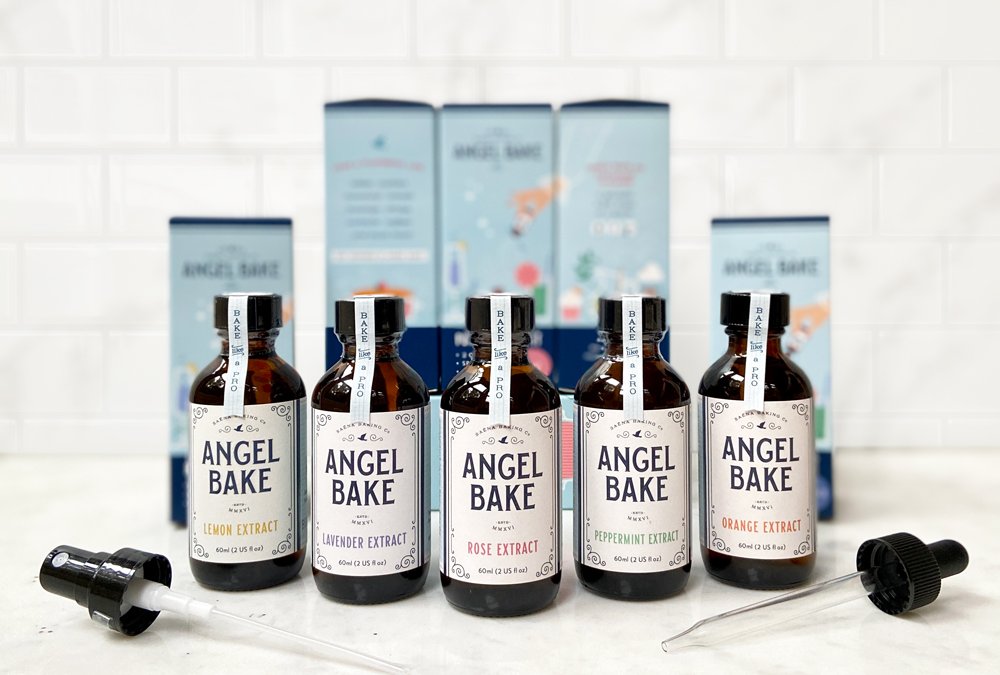
When purchasing a 2-ounce bottle of one of our premium Angel Bake extracts, such as Pure Lemon, Pure Cardamom, or Pure Lavender Extract, you may wonder: how long will it last? With our high-concentration extracts, a little truly goes a long way. In this blog post, we’ll walk you through the number of servings you can expect from one of our 2-ounce bottles, based on the recommended usage of 3-5 drops per cup of whatever you’re flavoring.
Why Only 3-5 Drops?
Angel Bake extracts are known for their high concentration. That means you get intense, authentic flavor with just a few drops. Unlike imitation extracts or lower-quality options that require larger amounts to achieve noticeable flavor, our extracts are potent—thanks to our meticulous distillation process and commitment to purity.
For most culinary applications—whether you’re adding flavor to baked goods, beverages, sauces, or savory dishes—our recommendation is to start with 3-5 drops per cup of the item you’re flavoring. This range allows flexibility for personal taste: some might prefer a subtle hint of flavor (3 drops), while others may prefer a more pronounced flavor (5 drops).
How Many Drops in a 2-Ounce Bottle?
Let’s break down the math to give you a clearer idea of how long your extract will last.
- 1 ounce = 6 teaspoons
- 1 teaspoon = approximately 98 drops
- 2-ounce bottle = 12 teaspoons = approximately 1,176 drops
This means that your 2-ounce bottle of extract contains approximately 1,176 drops of liquid.
How Many Servings?
Now that we know a 2-ounce bottle holds around 1,176 drops, let’s calculate the number of servings you’ll get:
- 3 drops per cup = about 392 servings (1,176 ÷ 3)
- 5 drops per cup = about 235 servings (1,176 ÷ 5)
So, depending on how many drops you use per cup, your bottle could yield anywhere from 235 to 392 servings!
Our extracts are versatile and can be used in a wide variety of culinary applications. Here are some popular uses:
- Baking: Infuse cakes, cookies, muffins, or frosting with your favorite extract flavor.
- Beverages: Add a few drops to your coffee, tea, or homemade lemonade for a refreshing twist.
- Sauces and Dressings: Enhance savory dishes with a splash of lavender, cardamom, or lemon extract.
- Cocktails: Impress your guests by adding extracts to cocktails for a burst of citrus, spice, or floral notes.
- Ice Cream & Sorbet: Add depth to your frozen desserts by flavoring them with our high-quality extracts.
Stretch Your Bottle, Not Your Budget
Because our extracts are so concentrated, you get more servings per bottle, which means you’re getting incredible value. Not only do you enjoy the highest quality flavor, but you also benefit from longevity—making Angel Bake extracts an excellent investment for your kitchen.
Pro Tip: Start Small
We always recommend starting with the lower end of the suggested range—3 drops per cup—and then adjusting to your taste. You can always add more if you desire a stronger flavor, but with the potency of our extracts, you’ll often find that less is more!
Conclusion: Long-Lasting Flavor, Exceptional Quality
With 235 to 392 servings per 2-ounce bottle, Angel Bake extracts provide exceptional value. Their high concentration ensures that a little goes a long way, helping you infuse every dish or beverage with the perfect amount of flavor. Whether you’re a home baker, a professional chef, or someone who loves experimenting in the kitchen, Angel Bake extracts are designed to meet all your culinary needs.
So next time you pick up a 2-ounce bottle of Angel Bake Pure Extract, you can rest assured that it will flavor your creations for weeks, or even months, to come.

At Saena Baking Co., precision matters in both flavor use and ingredient declaration. The following dosage ranges are Angel Bake starting recommendations. Adjust them for the individual flavor, recipe, process, and desired sensory result.
- Liquids and Recipes Without Baking: Begin with 3 to 5 drops per cup. This range works well for beverages, honey, fillings, syrups, creams, and other applications that are not exposed to baking temperatures.
- Baked Goods: Begin with 5 to 6 drops per cup. The additional flavor helps compensate for aroma that may be reduced during baking.
Taste and bench test before scaling. Some flavors may require less. A stronger sensory target or a demanding process may require more.
- Culinary Aromatics: Alcohol based, natural, unadulterated FTNF flavors for beverages, syrups, cocktails, finishing, aqueous systems, and compatible culinary applications.
- Pure Infusions: MCT based flavor oils that are often the optimal starting point for chocolate, cocoa liquor, ice cream, candy, cake batter, breads, buttercreams, fillings, sauces, dressings, and other oil or fat phase formulations. They also suit many high heat processes.
- Culinary Crystals: Made to order dry flavors for dry blending and immediate dispersion.
- Encapsulated Essences: Made to order dry flavors for applications that benefit from flavor protection during processing or storage.
Tips for Flavor and Aroma
In syrups, jams, sauces, and creams, later addition can help retain fresh aroma when the process allows it. In other products, earlier addition may be needed for dispersion or processing. Test the flavor in the actual formula and complete production cycle.
Culinary Aromatics can also be applied as a finishing mist. A light spray places concentrated aroma at the surface of a finished food, creating an effect similar to a culinary perfume. Establish the correct dosage and application method before service.
Declaring Flavor Ingredients
Ingredient declaration belongs in the product’s ingredient statement, not the Nutrition Facts panel. Saena provides product specifications to support the customer’s labeling review.
Depending on the product, formulation, jurisdiction, and applicable regulations, the declaration may use a term such as:
- Natural flavor or natural flavoring
- A named extract, when the specification and applicable standard support that declaration
Do not select a declaration from this article alone. Use the specification for the exact ingredient purchased and confirm the finished label with the responsible regulatory professional. Requirements can change according to product category, market, and jurisdiction.
Quality, Documentation, and Support
Angel Bake Culinary Aromatics are natural, unadulterated FTNF flavors. Saena can provide the appropriate product specification and discuss format selection, recommended use, and application testing without disclosing proprietary formulation details.
Explore Culinary Aromatics
Explore Pure Infusions
Compare all four lines in the Angel Bake flavor format guide, or contact Saena for technical and documentation support.