In the culinary world, presentation, flavor, and aroma are essential elements that define a truly memorable experience. At Saena, we’ve taken this to heart with our Culinary Aromatics line of pure flavoring extracts, equipped with a spritzer for effortless innovation. This unique tool transforms the way you finish dishes, beverages, and desserts, empowering chefs and food enthusiasts to infuse their creations with a mist of pure, natural flavors.
Why Spritz Flavor?
The spritzer isn’t just a convenient application method—it’s a gateway to deeper sensory expression. Spritzing allows for:
Even Distribution
Delicate mists ensure your extracts coat every bite or surface, creating balanced and consistent flavor profiles.
Enhanced Presentation
A gentle application imparts a sophisticated aromatic finish, enriching the sensory appeal of dishes and drinks.
Versatility
Spritz directly onto finished dishes, beverages, or even serving vessels like plates, cups, and glassware to leave a subtle signature aroma.
Aroma That Stays Fresh
One of the greatest benefits of spritzing is the freshness of aroma.
When dishes are prepared ahead of time, their aromatic top notes naturally fade—even if flavor remains. A spritzed plate restores brightness, immediacy, and freshness, delivering an aroma that greets diners the moment the dish arrives.
This is possible because alcohol-based formulations behave much like fine perfumes:
Water-based sprays simply cannot achieve the same aromatic lift or longevity.
Innovative Uses for Culinary Aromatics Spritzers
Dessert Finishing Touches
Spritz Bulgarian Rose or Lavender Extract onto macarons, cakes, puddings, honey, cheesecakes, or buttercreams for a refined floral note.
Beverage Enhancement
A light mist of Willamette Valley Peppermint or Valencia Orange over coffee, tea, or cocktails adds a refreshing burst of flavor and aroma.
Plated Presentations
Spritz Madagascar Vanilla or Chocolate Extract onto plates before plating desserts for an aromatic boost diners notice immediately.
Savory Innovations
A hint of Star Anise or Cardamom over roasted vegetables or grilled meats introduces surprising depth and contrast.
Creative Cocktails
Mist Lemon Extract around the rim of a glass for a bright aromatic signature with each sip.
Customizing Dining Vessels
Add flair by misting extracts onto serving platters, allowing aromas to softly complement the food.
Tips for Success
-
Experiment with Pairings: Choose complementary extracts for harmonious results.
-
Control the Intensity: A little goes a long way—begin with a light mist and build to preference.
-
Think Beyond the Plate: Spritzing can enhance not only food and drinks but also the sensory environment at the table.
Why Culinary Aromatics?
Crafted with precision and natural purity, Culinary Aromatics by Angel Bake ensures:
-
100% Natural Ingredients: No synthetic additives, Propylene Glycol, or imitation components.
-
Versatility: Suitable for desserts, savory dishes, beverages, plateware, and ambience.
-
Ease of Use: Designed for precision and control, supporting creativity while saving time.
-
Fresh Aroma Advantage: The alcohol-based system keeps aromatic notes vibrant—right when diners experience them.
Request Samples for High-Volume Projects
If you’re exploring new menu concepts, testing formulations, or building signature dishes, we offer samples for qualifying high-volume projects.
👉 Request Samples Here: https://www.angelbk.com/extract-sample-request/
Start Spritzing Today
Whether you’re a professional chef or a passionate home baker, Culinary Aromatics spritzers unlock new ways to shape flavor, aroma, and presentation. Visit our Instagram @angelbake for recipe inspiration and creative techniques.
Transform everyday dishes into memorable sensory experiences—one spritz at a time.
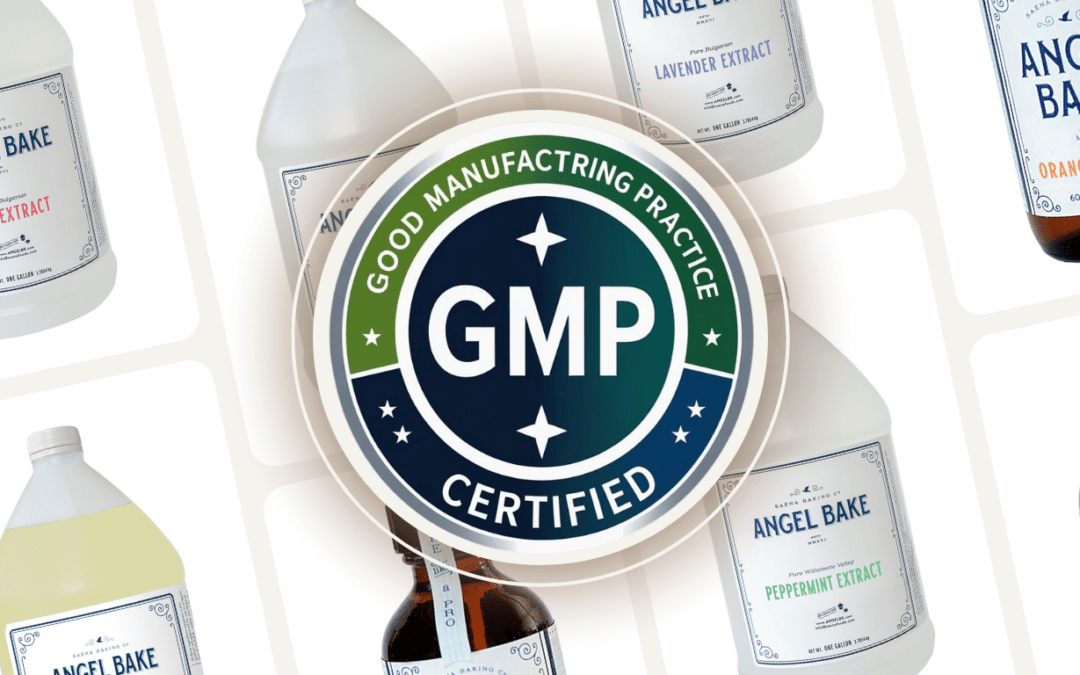
Saena Baking Co. Achieves NSF Good Manufacturing Practices Certification
We are proud to announce that Saena has successfully passed NSF Good Manufacturing Practices (GMP) audit with an impressive score of 95.
This independent, third-party audit reviewed every aspect of our production operations. It ensured we meet the highest standards of food safety and quality. The audit evaluated our facility, warehousing and manufacturing processes, employee practices, sanitation protocols, equipment maintenance, pest control, chemical control, packaging and labeling, and more. These are all key components of a robust GMP program.
Achieving this certification is a testament to our unwavering commitment to producing safe, high-quality pure extracts under the Angel Bake® brand. Our team worked diligently to prepare for this audit documenting all aspects of our operations. They implemented corrective actions where needed and ensured continuous improvement across our operations.
At Saena, we believe food safety is not a one-time accomplishment but a continual journey. That is why, alongside our GMP program, we have developed a full-scale HACCP program. This strengthens our food safety systems further. It ensures that products we produce meets the strictest safety standards while delivering the pure, authentic flavors our customers trust.
We are grateful to our team for their dedication and to our customers for their continued support. We look forward to continuing to provide you with the highest quality extracts, manufactured safely and responsibly at our Portland, Oregon facility.
Key Highlights:
-
NSF GMP audit completed on June 2, 2025 with a score of 95
-
Commitment to continuous improvement and food safety excellence
-
Full HACCP program underway to complement GMP systems
🔗 For more information about our quality standards and products, visit angelbk.com.
Who Regulates Flavor Products? Understanding the Roles of FDA, TTB, FEMA, and GRAS in the Flavor Industry
The world of flavor manufacturing is governed by several U.S. regulatory bodies and scientific panels that work together to ensure that products—like the pure flavoring extracts made at Saena under the Angel Bake® brand—are safe, transparent, and truthfully represented. Whether you are a chef, food manufacturer, or beverage developer, understanding who does what can help you make more informed decisions when selecting premium flavor ingredients.
Below is a clear breakdown of the major regulators and industry organizations behind flavor safety and compliance in the United States.
FDA — Food & Drug Administration
The U.S. Food & Drug Administration (FDA) oversees the safety of most food ingredients sold in the United States—including natural and artificial flavors.
Under the Federal Food, Drug, and Cosmetic Act, the FDA regulates:
-
Ingredient safety
-
Labeling and claims
-
Good Manufacturing Practices (GMP)
-
Food additives and flavoring substances
-
Adulteration and misbranding protections
For flavor manufacturers like Saena Baking Co., FDA regulations set the framework for:
-
Proper ingredient identity (e.g., “Pure Peppermint Extract”)
-
Safe manufacturing conditions
-
Accurate allergen declarations
-
Clean-label compliance
Learn more:
🔗 FDA on Food Ingredients and Packaging: https://www.fda.gov/food/food-ingredients-packaging
TTB — Alcohol and Tobacco Tax and Trade Bureau
The TTB regulates products that contain alcohol—including many flavor extracts that use alcohol as a solvent.
Extracts such as vanilla, citrus, and botanicals often fall under TTB oversight when they:
TTB’s role includes:
-
Regulating the use and storage of alcohol in manufacturing
-
Approving formulations for alcohol-based extracts
-
Monitoring tax compliance related to alcohol usage
Saena Baking Co. works with TTB-approved formulations to ensure that our alcohol-based extracts meet federal specifications for purity, composition, and manufacturing integrity.
Learn more:
🔗 TTB on Nonbeverage Products and Formulas: https://www.ttb.gov/nonbeverage-products
FEMA — Flavor and Extract Manufacturers Association
The Flavor and Extract Manufacturers Association (FEMA) is not a government agency but a scientific and regulatory industry body.
FEMA is responsible for:
-
Reviewing flavoring substances for safety
-
Publishing expert evaluations
-
Maintaining the FEMA GRAS program (Generally Recognized As Safe)
Many flavoring ingredients used in professional kitchens and food manufacturing facilities—including essential oils—are evaluated through FEMA’s expert panel.
FEMA helps the flavor industry maintain high standards of safety, scientific review, and regulatory alignment with FDA.
Learn more:
🔗 FEMA Official Website: https://www.femaflavor.org/
Understanding GRAS — “Generally Recognized As Safe”
GRAS is a regulatory designation that identifies substances considered safe for use in food under the conditions of intended use.
GRAS determinations can occur in two ways:
-
Through scientific procedures
— Independent experts review available research and determine safety.
-
Through common use in food prior to 1958
— Some ingredients are historically recognized as safe due to long-standing use.
Many natural flavor components—such as citrus oils, peppermint, vanilla, or rose derivatives—are recognized under FEMA GRAS or FDA GRAS criteria.
This provides manufacturers, chefs, and food developers assurance that:
-
The ingredient has undergone scientific review
-
It is accepted for safe use in foods
-
It meets U.S. regulatory expectations
Learn more:
🔗 FDA GRAS Overview: https://www.fda.gov/food/generally-recognized-safe-gras
How These Bodies Work Together
While their responsibilities differ, FDA, TTB, and FEMA collectively create a comprehensive system of oversight:
| Organization |
Role in Flavor Regulation |
| FDA |
Ensures ingredient safety, truthful labeling, GMP, and compliance with food laws |
| TTB |
Regulates alcohol used in extracts, approves formulas, oversees tax compliance |
| FEMA |
Conducts scientific evaluation of flavoring substances; manages FEMA GRAS listings |
| GRAS |
Provides a recognized safety framework for flavor chemicals and natural ingredients |
Angel Bake® extracts are produced within these regulatory frameworks to guarantee safety, purity, and consistency for both professional and home culinary applications.
Why This Matters for Chefs, Bakers, and Food Manufacturers
When you choose a flavoring product—especially for commercial use—you want assurance that:
-
Ingredients are safe and compliant
-
Manufacturing follows strict standards
-
Labels are accurate and transparent
In the World of High-Volume Flavor Manufacturing, Ingredient Purity Is Mission-Critical
What We Don’t Have Is Just as Important as What We Do Have
In flavor development, it’s possible to focus solely on taste and aroma. But when you’re manufacturing at scale—especially for private-label clients, co-manufacturers, or national distribution—what’s not in your ingredient list can make or break a product.
At Saëna, makers of Angel Bake Pure Extracts, we understand that for food manufacturers and contract producers, compliance isn’t optional—it’s foundational. That’s why our pure extracts are not only crafted for exceptional performance and flavor but also meticulously formulated to meet the strictest ingredient guidelines in the industry.
Why Ingredient Compliance Matters
When large grocery chains share a list of unacceptable ingredients with their suppliers, it’s not a suggestion—it’s a mandate. And failure to comply can mean lost contracts, costly reformulation, or delisting.
That’s why one of the nation’s leading honey manufacturers chose our Pure Bulgarian Lavender Extract to flavor a new botanical-infused honey. Our product passed their stringent compliance screening without a single issue—earning us a long-term place in their supply chain.
We steer clear of ingredients commonly flagged in retail and wholesale food policies, including but not limited to:
-
Synthetic colors and dyes
-
Artificial flavors and enhancers
-
Propylene glycol (used in many flavor carriers)
-
Preservatives like BHT or sodium benzoate
-
Genetically modified ingredients
-
Undisclosed allergens or derivatives
-
Chemical solvents beyond food-grade ethanol
-
Ingredients not listed as FEMA GRAS
Instead, our Angel Bake Extracts are made with integrity. We strive to deliver a clean-label flavoring solution that is:
- ✅ Non-GMO
- ✅ Certified Kosher
- ✅ Gluten-Free
- ✅ Made with Organic Ingredients
- ✅ No added sugars
- ✅ No food coloring
The Hidden Risk of the Wrong Flavor Supplier
A flavor might perform well in R&D—but if it contains non-compliant carriers or synthetic agents, it could be disqualified just before launch. Reformulating after failure costs more than just time—it can delay rollouts and damage brand trust.
With Angel Bake, our clients know they’re using a compliant, high-performing extract built for real-world food systems.
Made for Production. Trusted by Professionals.
Whether you’re flavoring honey, syrups, baked goods, or beverages, our extracts scale beautifully. They’re available in foodservice-friendly formats (including 1-gallon and 55-gallon drums) and integrate seamlessly into both small-batch and industrial lines.
Key Advantages:
-
✔️ Clean-label compliance
-
✔️ Reliable sourcing and documentation
-
✔️ Flavor consistency across batches
-
✔️ No artificial components
-
✔️ Ideal for national brand production
In short: when it comes to flavoring ingredients, what we don’t include matters just as much as what we do.
Our extracts are engineered for flavor—but built for trust, traceability, and performance at scale.
If you’re a food manufacturer or developer looking for a clean-label solution that delivers—reach out. We’re here to help.

Angel Bake French Macaron Baking Mix Detailed Instructions
Product Description
Angel Bake® French Macaron Baking Mix Single Step All-in French Macaron Baking Mix.
Product Specifications
- Ingredients: Sugar, Almond Flour, Egg Whites, Rice Starch, Polyglycerol Ester of Fatty Acids (E 475), Mono and Diglycerides of Fatty Acids(E471), Xanthan Gum
- Shelf Life: 24 months from production date
- Storage Instructions: Store in a cool, dry place, away from direct sunlight.
- Allergen Information: Contains almonds (nut allergen). Contains eggs. Gluten Free.
- Net Weight: 25 lbs.
- Country of Origin: USA
Mixing Instructions
- Prepare Batter:
- Combine macaron mix, water (0.20 Water ratio to mix), food coloring (optional), and flavoring extract (optional) in a mixer bowl.
-
-
- To hydrate 4KG of mix, use 4000 x 0.2 = 800 grams of water.
- Recommended water temperature: 122°F–130°F.
- Add food coloring at any stage of mixing to achieve varied visual effects.
- Flavoring the shells is optional—for best results, use low-moisture options like Pure Angel Bake® Extracts.
-
- Mix using a paddle attachment: LOW speed for 1 minute, then MEDIUM speed for 4 minutes.
- This baking mix has a high tolerance to varied whipping duration and speeds.
- Yield: 1000 grams of mix produces approximately 100 macaron shells.
Piping Instructions
-
- Pipe batter into 1-inch circles (8–10 grams per portion) on a silicone tray liner.
- Shell size can vary up to 3-4 inches in diameter.
- Tap trays to flatten batter.
- This step is optional. Batter flattens by itself. There are no air bubbles to pop.
- Lightly oil silicone tray liners to prevent sticking (apply 5–6 drops of vegetable oil across the mat, then wipe dry with a paper towel).
- Only do this if lopsided shells are observed.
Baking Instructions
-
- Preheat convection oven to 280°F.
- Oven temp and cooking times depend on the type of oven, convection fan settings and shell size. The batter bakes the same as traditional recipes. Shells can be baked at 240 °F – 300 °F.
- There is no need to rest the shells when using convection type ovens. The circulating hot air will dry the surface before the shells rise.
- Shells can rest for up to 30 mins prior to baking.
- Bake macaron shells for 16-17 minutes.
- Allow the shells to cool completely before removing them from tray.
Technical Data
-
- Water Absorption: 0.20-0.21 water to mix ratio. To hydrate 1000 grams of mix use (1000 x 0.2 = 200 grams) of water.
- Recommended Water Temp: 122°F–130°F
- Yield: Approximately 100 macaron shells per 1000 grams of mix
- Recommended Baking Temp: 280°F (convection)