Adding flavor to honey changes what the product is called, what the ingredient statement says, and in some cases what has to appear on the front of the jar. None of it is complicated. It catches producers who have only ever labeled straight honey, and it is far cheaper to know before the artwork goes to print than after.
The short version
- It is no longer just honey. The product name has to describe the characterizing flavor.
- The ingredient statement reads honey, then natural flavor.
- A qualifier may be required on the front panel, at half the height of the flavor name.
- Whether it is required depends entirely on how your flavor supplier built the flavor.
- In a multi flavor pack with shared label copy, one flavor can put that qualifier on all of them.
What this is, and what it is not.
This is a plain summary written from a flavor supplier’s side of the table. It is information about how flavors declare, not legal advice about your package. Your regulatory counsel makes the final call on your label.
Once you add flavor, it is not labeled as honey
FDA has published guidance on the proper labeling of honey and honey products. The relevant point for a flavored product is that when a flavor is added and the labeling represents that flavor, the product name must describe the characterizing flavor. The guidance uses the pattern raspberry flavored honey.
Simply calling the product honey is not correct once flavor is in it.
The varietal trap
A name like lavender honey reads to most shoppers as a varietal claim, meaning honey the bees produced from lavender nectar. That is a different product from honey that has had lavender flavor added to it. If yours is the second thing, the name needs to make that clear.
The ingredient statement
Components are listed by common name in descending order of predominance by weight. For a straightforward flavored honey, that is honey followed by natural flavor.
Two things people ask about. The carrier a flavor is built on is part of the flavor and is generally not called out separately, though a supplier should be able to tell you exactly what is in it and confirm how it declares.
And if you have added anything else, a sweetener, an acid, a preservative, a botanical inclusion, it belongs in the statement too. Adding a second sweetener changes the product name as well.
The qualifier that can land on your front panel
This is the rule that surprises people, and it comes from the flavor labeling regulations rather than the honey guidance. Simplified, there are three cases.
| If the characterizing flavor is |
The label result |
| Derived entirely from the food being named |
The flavor name can stand on its own. No qualifier needed. |
| Derived from the named food, plus other natural flavor that reinforces or rounds it |
The name must be accompanied by with other natural flavors, set at no less than half the height of the characterizing flavor name. |
| Simulated using natural flavor from a different source |
The label must identify the source actually used, or declare the product artificially flavored. |
The qualifier cannot be shrunk into a corner. It sits in your primary display panel, sized against the flavor name.
That half height requirement is what makes this a commercial issue rather than a compliance footnote. The flavor name is generally the largest type on the front of the jar, which sets how much room the qualifier takes with it.
FTNF and WONF, in plain terms
These abbreviations are flavor industry shorthand rather than regulatory terms, but you will hear them from any supplier and they map directly onto the three cases above.
- FTNF, from the named food. Every flavoring component derives from the food being named. An FTNF lavender is built from lavender and nothing else. It does not trigger the qualifier.
- WONF, with other natural flavors. The flavor starts with the named food, then uses natural flavor materials from other sources to build or reinforce the profile. It triggers the qualifier.
A WONF flavor is still entirely natural.
The other natural flavors in the name are exactly that, natural. The qualifier says nothing about synthetic or artificial ingredients. It is a statement about where the flavor came from, not about what kind of flavor it is.
Most commercial botanical flavors are WONF, and that is not a criticism of them. Building a lavender or a chamomile that is stable, consistent, and affordable from that botanical alone is genuinely difficult, and WONF is how most of the industry solves it.
But it is a choice with a labeling consequence, and it is worth knowing what WONF means on a flavor label before the label is designed rather than after.
A worked example: one flavor, a whole line affected
Here is a pattern worth watching for if you produce a multi flavor set or a gift pack.
Imagine a three jar flavored honey set where the packaging carries a single shared piece of label copy across all three products. This is common, because it is cheaper to print and simpler to manage. Two of the flavors come from one supplier and the third from another.
If any one of those flavor systems is a WONF, the qualifier has to appear. And because the copy is shared, it appears across the whole set. The jars whose flavors did not require it carry it anyway.
The practical consequence.
A single supplier choice on one product can determine the front panel of an entire line. If a shorter statement of identity matters to your brand or to your retail customer, audit the composition of every flavor in the set, not only the one you are currently reformulating.
Questions to settle before the artwork goes to print
- Is each flavor FTNF or WONF? Get it in writing, per flavor, not per supplier.
- What is the exact declaration language for each flavor in the ingredient statement?
- Does the product name make clear that the flavor was added rather than derived from the floral source?
- If it is a multi pack with shared copy, has every flavor been checked, not just the new one?
- Does anything else you have added need to appear in the statement, or change the product name?
What this does not cover
This piece is about the flavor related parts of a flavored honey label. It does not address net quantity, nutrition labeling, allergen declarations, country of origin, organic or raw claims, state level requirements, or the other elements a complete label has to satisfy.
It is also not legal advice. Take your draft panel to your regulatory counsel before you print.
For the technical side of choosing a flavor system, see our piece on flavored honey production.
Need the declaration language for a flavor you are considering?
We will send it, along with the specification sheet stating whether the flavor is built from the named food only, and the rest of our documentation. Useful before the artwork goes to print rather than after.
Most people think of flavor as a single step: you add something to a recipe, and it tastes like that thing. In practice, flavor is applied to food and drink in several distinct ways, and understanding the differences is the key to getting the result you actually want, whether you’re making a latte at home, developing a dessert menu, or formulating a product at scale.
There are four broad approaches: flavoring, aromatization, finishing, and enhancement. Each one answers a different question. When does the flavor go in? Where does it act, in the food itself, in the air above it, or on the surface? Why are you adding it, to build a profile from scratch or to lift one that’s already there? This guide walks through all four, with examples of when each is the right tool and which kind of flavor is built for the job.
Flavoring
Flavoring is the most familiar approach: direct incorporation into a food or beverage as it’s being made. The flavor becomes part of the formulation itself, distributed through the whole product.
This is what’s happening when you flavor a batch of cookies, stir a botanical profile into a syrup, build a cocktail, or develop a nutritional product. The flavor is in the mix, fully integrated, and every bite or sip carries it. Flavoring is the foundation of most recipes and the starting point for most product development. It’s how you establish the core character of what you’re making.
Common flavoring applications include coffee and tea beverages, baked goods, chocolate and confectionery, sauces and dressings, syrups, ice cream, and nutritional products.
For most flavoring work, Angel Bake’s Culinary Aromatics® liquid extracts are the versatile choice: concentrated, true-to-nature profiles that blend cleanly into beverages, batters, and syrups. For fat-based systems like chocolate, ganache, and compound coatings, our Pure Infusions™ flavor oils are designed to carry flavor where water-based products separate or seize. Choosing between them comes down to your application, and our guide to which flavor format is right for your application walks through it.
Aromatization
Aromatization is about aroma rather than taste. It applies scent to an ingredient, a vessel, or a finished product. Because so much of what we experience as “flavor” is actually smell, aromatization can transform a product’s character without changing its underlying composition.
This is the approach behind aromatizing coffee beans or tea leaves before they’re brewed, scenting a cocktail glass before the drink is poured, or adding an aromatic dimension to a tasting flight or specialty presentation. The aroma does work that taste alone can’t: it sets an expectation, adds complexity, and engages the sense that drives most of flavor perception.
Common aromatization applications include aromatizing coffee beans and roasted coffee, tea leaves and herbal blends, cocktail glassware and beverage vessels, dessert plates, tasting flights, and retail culinary kits.
This is exactly what Angel Bake’s Culinary Aromatics® line is designed to do. It was built with aromatization in mind: it delivers a concentrated, true-to-nature aroma that releases cleanly and lifts immediately, without leaving behind the added moisture that water-based products carry into your ingredient or vessel. That matters most with moisture-sensitive items like coffee beans, tea leaves, and dry blends, where you want the scent and not the dampness. It’s also remarkably good at restoring the bright, fresh top notes that quietly escape coffee, tea, and spices after any length of time in storage, bringing a just-opened liveliness back to ingredients that have gone flat. When aroma is the goal, this is the line to reach for.
Finishing
Finishing is flavor or aroma applied at the very last stage, at the moment a dish or drink is completed or served. Where flavoring builds the profile during production, finishing adds a final, immediate layer of aroma and flavor right before the product reaches the person enjoying it.
A fine-mist application is especially suited to finishing because it lays down flavor precisely and evenly across a surface without adding bulk or moisture. Think of the aromatic lift on top of a latte just before it’s handed across the counter, a mist over a plated dessert as it leaves the kitchen, or a finishing touch on a cocktail at the moment of service. Finishing is where presentation and aroma meet: it’s the first thing the guest notices, and it makes the experience feel fresh and intentional.
Common finishing applications include lattes, cappuccinos, and espresso drinks, cold brew, cocktails and mocktails, ice cream, chocolate, and plated desserts.
Here again, Culinary Aromatics® is in its element. The same clean, moisture-free aroma delivery that makes it ideal for aromatization makes it a natural finishing tool. A light mist sets a fresh aromatic top note on a drink or plate at the moment of service, without diluting or watering down what’s underneath. For service environments and home use alike, it’s a fast, repeatable way to make every cup or plate feel freshly made.
Enhancement
Enhancement uses flavor to support or intensify a profile that’s already present. Rather than introducing a brand-new character, enhancement deepens, rounds out, or reinforces what a product already has, filling in gaps, boosting a note that’s faded, or adding dimension to something that tastes flat.
This is the quiet workhorse of flavor application. It’s what’s happening when a touch of complementary flavor makes a honey taste more like itself, when a beverage concentrate gets a lift before bottling, or when a sauce, dressing, or dairy product gains depth it was missing. Done well, enhancement isn’t noticed as a separate flavor at all. The product simply tastes better, fuller, and more complete.
Common enhancement applications include honey and syrups, beverage concentrates, sauces, dressings, and marinades, dairy products, frozen desserts, chocolate fillings, and specialty culinary products.
Because enhancement is about reinforcing rather than overpowering, it rewards concentrated, true-to-nature flavor used with a light hand, which is the heart of the Angel Bake range. A small amount of Culinary Aromatics® lifts a beverage or syrup, while Pure Infusions™ rounds out chocolate fillings and fat-based sauces. The goal is the same either way: a finished product that tastes more like the best version of itself.
Choosing the right approach
These four approaches aren’t mutually exclusive, and most real-world products use more than one. A signature latte might be flavored with a syrup, finished with an aromatic mist, and served in an aromatized glass. A dessert program might enhance a base recipe and finish each plate at service. The point isn’t to pick a single method but to understand what each one does, so you can combine them deliberately.
The other half of the decision is format: whether a liquid, oil, granulated, or powdered flavor best fits your product and process. A flavor’s delivery format determines how it behaves in a given application. For help there, see our guide to which flavor format is right for your application, our look at what carrier is in your flavor, and the differences between oil-based and alcohol-based flavor.
Explore the full range of Angel Bake flavors at angelbk.com.
An Angel Bake post by Saena Baking Co.
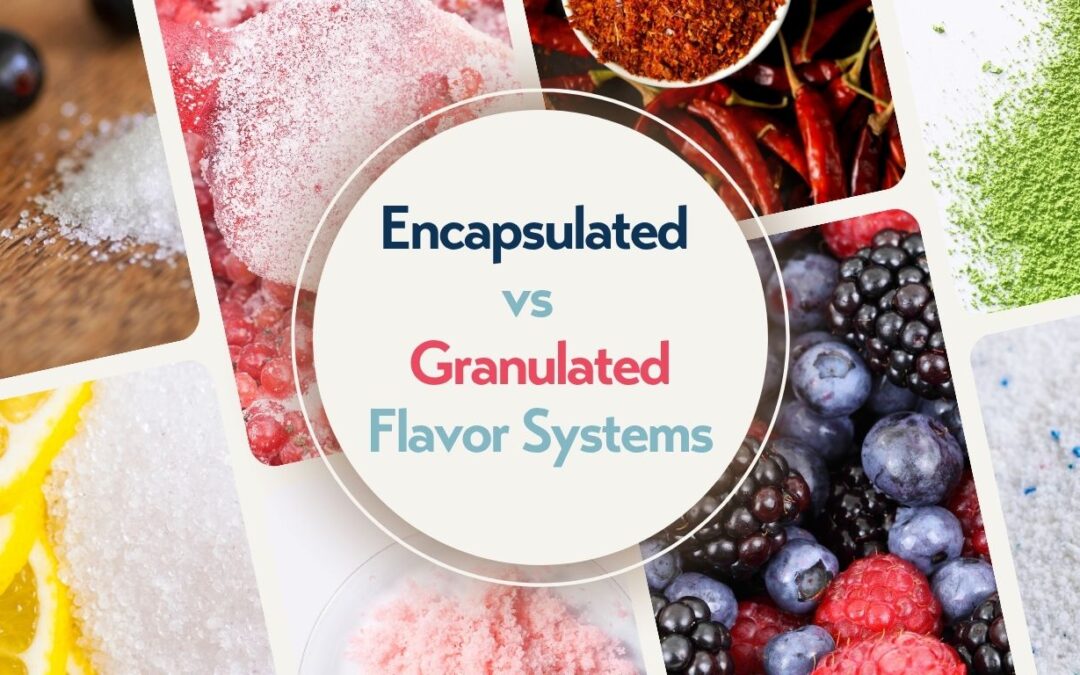
When a flavor needs to go into a dry product — a seasoning blend, a protein powder, a dry beverage mix — a liquid extract or flavor oil often isn’t the right tool. Dry products call for dry flavor. But “dry flavor” isn’t a single thing: it comes in two distinct formats, granulated and encapsulated, and they solve different problems.
Choosing between them isn’t about which is better — it’s about what your product and process demand. This guide compares the two on the dimensions that actually drive the decision: how the flavor is protected, how it behaves in processing, and which applications each one fits.
The core difference
The simplest way to understand the two formats is by what each is built to do.
Granulated flavor is dry flavor in a free-flowing, granular form. Its job is clean handling and even distribution — it blends uniformly through other dry ingredients and disperses consistently across a formulation. Granulated flavor is the natural choice when you’re building a dry blend and need the flavor to mix in evenly and behave predictably.
Encapsulated flavor is flavor that has been wrapped in a protective layer through microencapsulation. Its job is protection — shielding the flavor compounds from heat, moisture, oxidation, and time so they survive demanding production and reach the finished product intact. Encapsulated flavor is the natural choice when the process or the shelf life would otherwise degrade an unprotected flavor.
Put simply: granulated is about distribution, encapsulated is about protection. Many dry products could use either; the deciding factor is whether your process is gentle enough that distribution is the only concern, or demanding enough that protection becomes the priority.
When granulated is the right fit
Granulated flavor suits dry applications where the flavor doesn’t face severe heat, moisture, or extended processing stress — where the main requirement is that it blends cleanly and distributes evenly. It’s valued by seasoning manufacturers, dry-mix producers, beverage formulators, and foodservice operators for its handling convenience and consistent dispersion.
Typical granulated applications include spice blends and dry rubs, seasoning blends, tea blends, baking and pancake mixes, popcorn seasonings and snack coatings, instant beverage mixes, and specialty retail seasonings.
When encapsulated is the right fit
Encapsulated flavor suits applications where the flavor has to survive something — high heat during processing, moisture in the formulation, a long shelf life, or a demanding manufacturing environment. The protective encapsulation helps preserve flavor integrity through conditions that would degrade an unprotected flavor, which is why it’s built for commercial manufacturers, beverage producers, nutraceutical companies, and dry-mix formulators with challenging processing requirements.
Typical encapsulated applications include protein and greens powders, hydration products and electrolyte mixes, meal replacements and nutritional beverages, instant coffee and tea, commercial baking, gummies and functional foods, and dry beverage and ready-to-mix products.
A side-by-side comparison
|
Granulated Flavor |
Encapsulated Flavor |
| Primary job |
Even distribution in dry blends |
Protecting flavor through processing |
| Best when |
Process is gentle; blending is the priority |
Process is demanding; survival is the priority |
| Handles heat & moisture |
Standard dry-handling conditions |
Built for heat, moisture, and stress |
| Shelf-life demands |
Standard |
Extended / challenging |
| Typical buyers |
Seasoning & dry-mix producers, foodservice |
Nutraceutical, beverage & commercial manufacturers |
| Example uses |
Rubs, seasoning blends, baking mixes |
Protein powders, gummies, commercial baking |
How to decide
Start with your process, not the flavor. Ask: what will this flavor have to endure between the moment it’s added and the moment someone consumes the finished product? If the answer is “not much — it just needs to blend in and distribute evenly,” granulated is likely the efficient choice. If the answer involves high heat, moisture, a long shelf life, or aggressive processing, encapsulation earns its place by protecting what you’re paying for.
Both formats share the same foundation: clean-label formulation, non-GMO and gluten-free compatibility, and production in a dedicated gluten-free, allergen-free facility. Both are also offered as commercial and private-label programs on a made-to-order basis, so the right starting point is a conversation about your specifications, volumes, and processing conditions.
This post is part of our broader guide to flavor application and complements our overview of which flavor format is right for your application. To discuss a granulated or encapsulated program for your product, contact our team — we’ll help you match the format to your process and provide the documentation your formulation requires.
An Angel Bake post by Saena Baking Co.
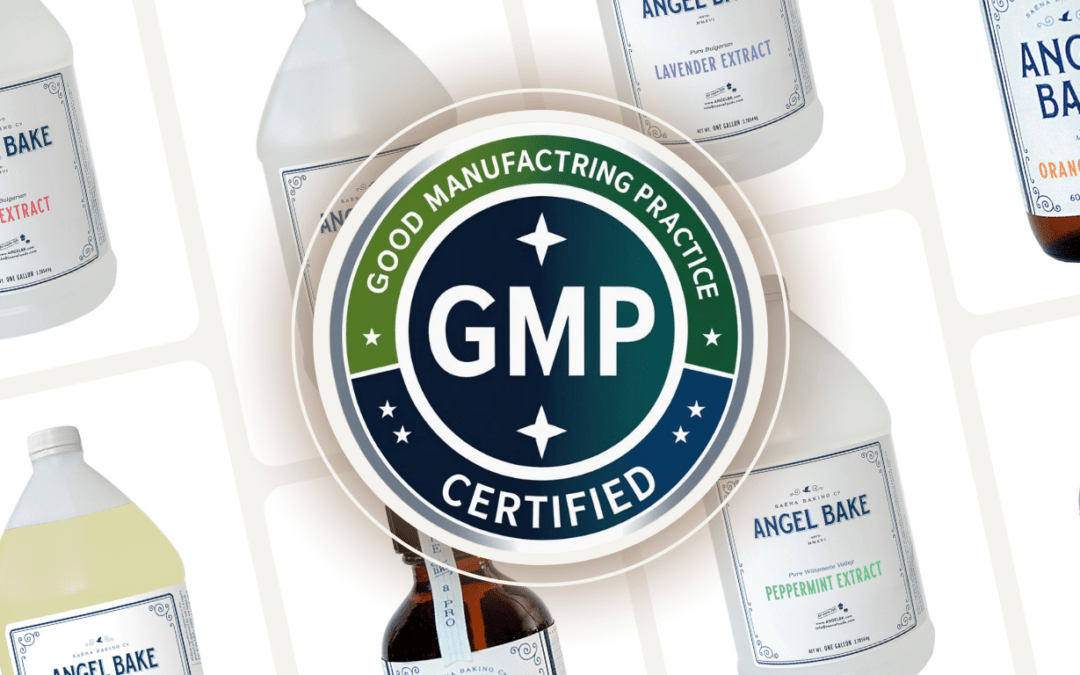
We are proud to announce that Saena has successfully passed NSF Good Manufacturing Practices (GMP) audit with an impressive score of 95.
This independent, third-party audit reviewed every aspect of our production operations. It ensured we meet the highest standards of food safety and quality. The audit evaluated our facility, warehousing and manufacturing processes, employee practices, sanitation protocols, equipment maintenance, pest control, chemical control, packaging and labeling, and more. These are all key components of a robust GMP program.
Achieving this certification is a testament to our unwavering commitment to producing safe, high-quality pure extracts under the Angel Bake™ brand. Our team worked diligently to prepare for this audit documenting all aspects of our operations. They implemented corrective actions where needed and ensured continuous improvement across our operations.
At Saena, we believe food safety is not a one-time accomplishment but a continual journey. That is why, alongside our GMP program, we have developed a full-scale HACCP program. This strengthens our food safety systems further. It ensures that products we produce meets the strictest safety standards while delivering the pure, authentic flavors our customer expect.
We are grateful to our team for their dedication and to our customers for their continued support. We look forward to continuing to provide you with the highest quality extracts, manufactured safely and responsibly at our Portland, Oregon facility.
Key Highlights:
-
NSF GMP audit completed on June 2, 2025 with a score of 95
-
Commitment to continuous improvement and food safety excellence
-
Full HACCP program underway to complement GMP systems
🔗 For more information about our quality standards and products, visit angelbk.com.
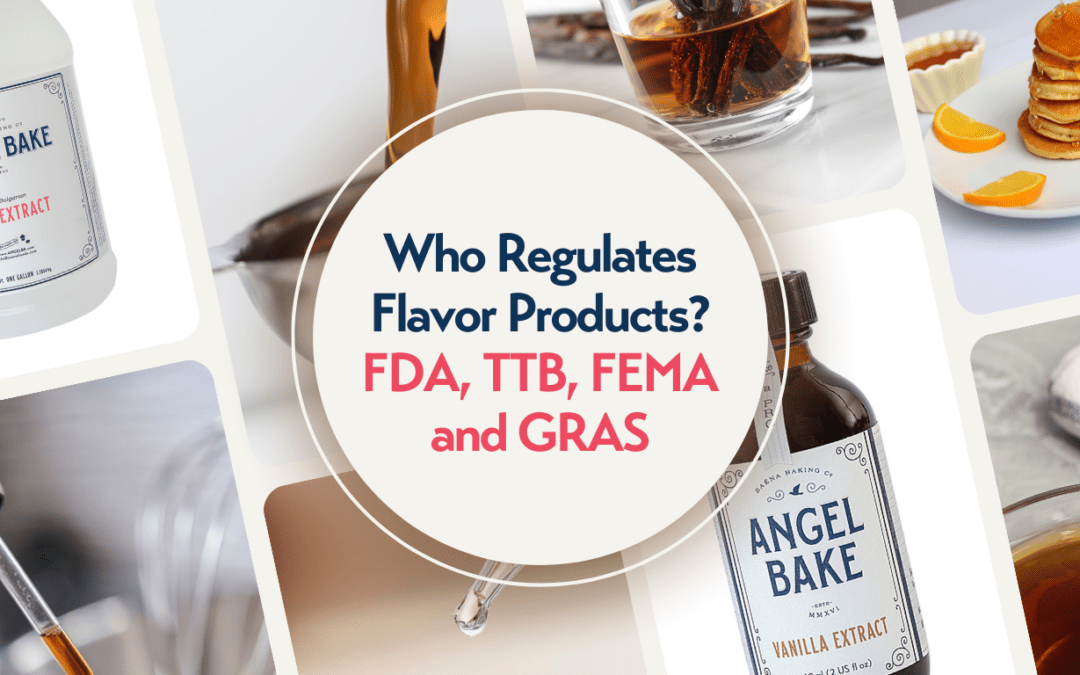
Who Regulates Flavor Products? Understanding the Roles of FDA, TTB, FEMA, and GRAS in the Flavor Industry
The world of flavor manufacturing is governed by several U.S. regulatory bodies and scientific panels that work together to ensure that products—like the pure flavoring extracts made at Saena under the Angel Bake™ brand—are safe, transparent, and truthfully represented. Whether you are a chef, food manufacturer, or beverage developer, understanding who does what can help you make more informed decisions when selecting premium flavor ingredients.
Below is a clear breakdown of the major regulators and industry organizations behind flavor safety and compliance in the United States.
FDA — Food & Drug Administration
The U.S. Food & Drug Administration (FDA) oversees the safety of most food ingredients sold in the United States—including natural and artificial flavors.
Under the Federal Food, Drug, and Cosmetic Act, the FDA regulates:
-
Ingredient safety
-
Labeling and claims
-
Good Manufacturing Practices (GMP)
-
Food additives and flavoring substances
-
Adulteration and misbranding protections
For flavor manufacturers like Saena Baking Co., FDA regulations set the framework for:
-
Proper ingredient identity (e.g., “Pure Peppermint Extract”)
-
Safe manufacturing conditions
-
Accurate allergen declarations
-
Clean-label compliance
Learn more:
🔗 FDA on Food Ingredients and Packaging: https://www.fda.gov/food/food-ingredients-packaging
TTB — Alcohol and Tobacco Tax and Trade Bureau
The TTB regulates products that contain alcohol—including many flavor extracts that use alcohol as a solvent.
Extracts such as vanilla, citrus, and botanicals often fall under TTB oversight when they:
TTB’s role includes:
-
Regulating the use and storage of alcohol in manufacturing
-
Approving formulations for alcohol-based extracts
-
Monitoring tax compliance related to alcohol usage
Saena Baking Co. works with TTB-approved formulations to ensure that our alcohol-based extracts meet federal specifications for purity, composition, and manufacturing integrity.
Learn more:
🔗 TTB on Nonbeverage Products and Formulas: https://www.ttb.gov/nonbeverage-products
FEMA — Flavor and Extract Manufacturers Association
The Flavor and Extract Manufacturers Association (FEMA) is not a government agency but a scientific and regulatory industry body.
FEMA is responsible for:
-
Reviewing flavoring substances for safety
-
Publishing expert evaluations
-
Maintaining the FEMA GRAS program (Generally Recognized As Safe)
Many flavoring ingredients used in professional kitchens and food manufacturing facilities—including essential oils—are evaluated through FEMA’s expert panel.
FEMA helps the flavor industry maintain high standards of safety, scientific review, and regulatory alignment with FDA.
Learn more:
🔗 FEMA Official Website: https://www.femaflavor.org/
Understanding GRAS — “Generally Recognized As Safe”
GRAS is a regulatory designation that identifies substances considered safe for use in food under the conditions of intended use.
GRAS determinations can occur in two ways:
-
Through scientific procedures
— Independent experts review available research and determine safety.
-
Through common use in food prior to 1958
— Some ingredients are historically recognized as safe due to long-standing use.
Many natural flavor components—such as citrus oils, peppermint, vanilla, or rose derivatives—are recognized under FEMA GRAS or FDA GRAS criteria.
This provides manufacturers, chefs, and food developers assurance that:
-
The ingredient has undergone scientific review
-
It is accepted for safe use in foods
-
It meets U.S. regulatory expectations
Learn more:
🔗 FDA GRAS Overview: https://www.fda.gov/food/generally-recognized-safe-gras
How These Bodies Work Together
While their responsibilities differ, FDA, TTB, and FEMA collectively create a comprehensive system of oversight:
| Organization |
Role in Flavor Regulation |
| FDA |
Ensures ingredient safety, truthful labeling, GMP, and compliance with food laws |
| TTB |
Regulates alcohol used in extracts, approves formulas, oversees tax compliance |
| FEMA |
Conducts scientific evaluation of flavoring substances; manages FEMA GRAS listings |
| GRAS |
Provides a recognized safety framework for flavor chemicals and natural ingredients |
Angel Bake™ extracts are produced within these regulatory frameworks to guarantee safety, purity, and consistency for both professional and home culinary applications.
Why This Matters for Chefs, Bakers, and Food Manufacturers
When you choose a flavoring product—especially for commercial use—you want assurance that:
-
Ingredients are safe and compliant
-
Manufacturing follows strict standards
-
Labels are accurate and transparent
What We Don’t Have Is Just as Important as What We Do Have
In flavor development, it’s possible to focus solely on taste and aroma. But when you’re manufacturing at scale—especially for private-label clients, co-manufacturers, or national distribution—what’s not in your ingredient list can make or break a product.
At Seana, makers of Angel Bake Pure Extracts, we understand that for food manufacturers and contract producers, compliance isn’t optional—it’s foundational. That’s why our pure extracts are not only crafted for exceptional performance and flavor but also meticulously formulated to meet the strictest ingredient guidelines in the industry.
Why Ingredient Compliance Matters
When large grocery chains share a list of unacceptable ingredients with their suppliers, it’s not a suggestion—it’s a mandate. And failure to comply can mean lost contracts, costly reformulation, or delisting.
That’s why one of the nation’s leading honey manufacturers chose our Pure Bulgarian Lavender Extract to flavor a new botanical-infused honey. Our product passed their stringent compliance screening without a single issue—earning us a long-term place in their supply chain.
We steer clear of ingredients commonly flagged in retail and wholesale food policies, including but not limited to:
-
Synthetic colors and dyes
-
Artificial flavors and enhancers
-
Propylene glycol (used in many flavor carriers)
-
Preservatives like BHT or sodium benzoate
-
Genetically modified ingredients
-
Undisclosed allergens or derivatives
-
Chemical solvents beyond food-grade ethanol
-
Ingredients not listed as FEMA GRAS
Instead, our Angel Bake Extracts are made with integrity. We strive to deliver a clean-label flavoring solution that is:
- ✅ Non-GMO
- ✅ Certified Kosher
- ✅ Gluten-Free
- ✅ Made with Organic Ingredients
- ✅ No added sugars
- ✅ No food coloring
The Hidden Risk of the Wrong Flavor Supplier
A flavor might perform well in R&D—but if it contains non-compliant carriers or synthetic agents, it could be disqualified just before launch. Reformulating after failure costs more than just time—it can delay rollouts and damage brand trust.
With Angel Bake, our clients know they’re using a compliant, high-performing extract built for real-world food systems.
Made for Production. Trusted by Professionals.
Whether you’re flavoring honey, syrups, baked goods, or beverages, our extracts scale beautifully. They’re available in foodservice-friendly formats (including 1-gallon and 55-gallon drums) and integrate seamlessly into both small-batch and industrial lines.
Key Advantages:
-
✔️ Clean-label compliance
-
✔️ Reliable sourcing and documentation
-
✔️ Flavor consistency across batches
-
✔️ No artificial components
-
✔️ Ideal for national brand production
In short: when it comes to flavoring ingredients, what we don’t include matters just as much as what we do.
Our extracts are engineered for flavor—but built for trust, traceability, and performance at scale.
If you’re a food manufacturer or developer looking for a clean-label solution that delivers—reach out. We’re here to help.